Carbon Fiber Electric Hydrofoil Surfboard
Carbon Fiber Electric Hydrofoil Surfboard
Electric hydrofoil surfboards combine carbon fiber composite structures with electric propulsion systems to enable foil-assisted riding on various water surfaces. The carbon fiber construction provides high stiffness-to-weight ratio essential for maintaining foil stability at speed, while the integrated electric drive delivers consistent thrust independent of wave conditions. This technology allows riders to achieve lift-off and sustained flight above water at lower speeds than traditional surf-dependent foiling.
Structural Design and Material Composition
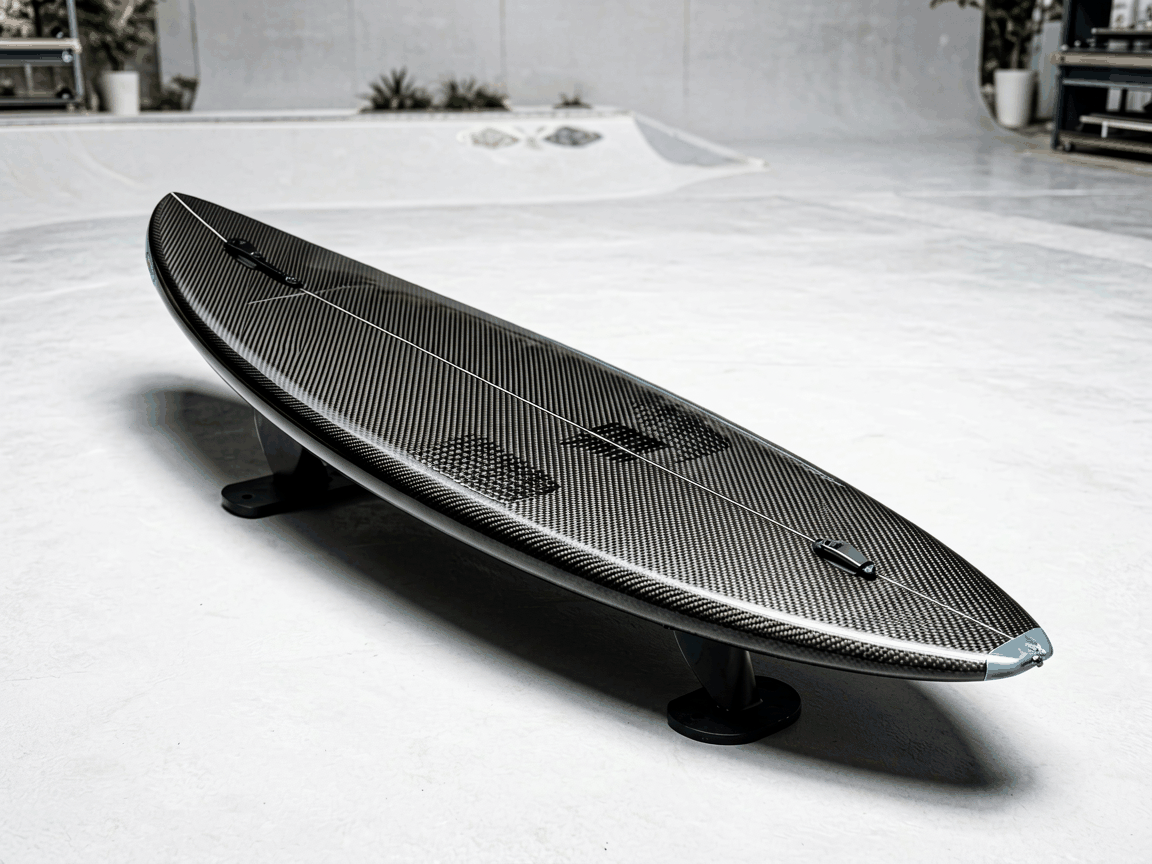
The board's primary structure utilizes unidirectional and woven carbon fiber plies laminated with epoxy resin, optimized through finite element analysis to distribute loads from rider weight, thrust forces, and hydrodynamic pressure during foiling. Typical laminate schedules place 0° and ±45° orientations in high-stress zones such as the mast connection and nose region, achieving flexural rigidity between 120–180 N·m² depending on board length. Core materials vary by model: high-density PVC foam (60–80 kg/m³) is common in consumer variants, while aerospace-grade Nomex honeycomb may be specified for industrial or rental fleets requiring impact resistance.
The mast and fuselage are typically manufactured as monolithic carbon fiber tubes with internal reinforcement ribs to resist torsional twist under lateral loading during turns. Wall thickness ranges from 2.5 to 4.0 mm based on mast length (usually 70–90 cm), with outer diameters between 65–85 mm to balance stiffness and hydrodynamic drag. Fuselage sections connect to the mast and wings via precision-machined aluminum or titanium interfaces, designed to accommodate modular wing systems for different performance profiles.
Propulsion System Specifications
Electric drive units are integrated into the mast or fuselage, featuring sealed brushless DC motors with power ratings typically between 5–15 kW continuous, depending on intended use case. Voltage systems operate at 40–60 V DC nominal, supplied by lithium-ion battery packs with capacities ranging from 30–60 Ah, delivering 60–90 minutes of runtime at moderate throttle. Motor efficiency exceeds 85% across the operating range, with thermal management achieved through conduction cooling via the carbon fiber structure and optional active water jackets.
Propellers are constructed from corrosion-resistant alloys or carbon fiber-reinforced composites, with diameters between 180–220 mm and pitch adjustable via interchangeable blades or variable-pitch mechanisms in higher-end models. Thrust output ranges from 150–300 N, sufficient to lift a 75–90 kg rider with board and battery at speeds of 8–12 km/h. Control is managed via waterproof handheld remotes or wrist-mounted units using 2.4 GHz or Bluetooth Low Energy communication, with throttle response latency under 100 ms and multiple riding modes (e.g., eco, sport, cruise) adjustable through firmware.
Hydrofoil Wing Configuration and Performance
Front wings typically range from 600–900 mm in span with aspect ratios between 5–8, influencing lift generation and drag characteristics. Lower aspect ratio wings (e.g., 600 mm span, 120 mm chord) provide higher lift at low speeds, beneficial for beginners or heavier riders, while higher aspect ratio designs (e.g., 800 mm span, 100 mm chord) reduce induced drag for improved efficiency and top speed. Rear stabilizer wings are generally 250–350 mm span with symmetrical or slightly cambered profiles to ensure pitch stability.
Lift-off speed depends on wing loading, typically between 8–14 km/h for standard configurations, with maximum speeds reaching 25–35 km/h limited by motor power, cavitation onset, and structural vibration thresholds. Angle of attack is adjustable via shims or movable fuselage mounts, allowing tuning for different water conditions (e.g., choppy vs. flat) or rider preference. All submerged components undergo cathodic protection or use marine-grade materials to mitigate galvanic corrosion in saltwater environments.
Applications in Commercial and Industrial Settings
Beyond recreation, carbon fiber electric hydrofoil surfboards serve specialized roles in water patrol, marine research, and coastal inspection where traditional boats face access limitations. Their low draft (typically <15 cm when foiling) enables operation in shallow waters, seagrass beds, or near submerged infrastructure without environmental disturbance. Electric propulsion ensures zero emissions and minimal noise, critical for wildlife monitoring or operations in protected zones where internal combustion engines are restricted.
In training environments, these boards provide consistent, repeatable conditions for hydrofoil skill development, unaffected by wave variability. Instructors can maintain precise speed control via remote throttle, allowing students to focus on balance and foil control rather than paddling or wave timing. Rental operations benefit from reduced maintenance compared to fuel-powered watercraft, with no oil changes, winterization, or fuel system upkeep required—only battery care and rinsing after saltwater use.
Manufacturing and Quality Considerations
Production involves vacuum bagging or autoclave curing of carbon fiber prepregs to achieve void content below 2%, ensuring consistent mechanical properties. Non-destructive testing includes ultrasonic scanning of critical joints and thermographic inspection of battery enclosures to detect delamination or thermal anomalies. Dimensional tolerances for mast-to-fuselage interfaces are held to ±0.15 mm to prevent play that could lead to vibration or premature wear.
Battery systems undergo cell balancing, insulation resistance testing (>500 MΩ), and pressure cycling to validate sealing integrity to IP68 standards. Finished units are subjected to static load tests (e.g., 1.5× maximum rider weight) and dynamic fatigue simulations representing 100+ hours of operational stress. Corrosion resistance is validated through salt spray testing (ASTM B117) for 500+ hours with acceptable coating adhesion per ASTM D3359.
Customization and Configuration Options
Board length can be tailored between 140–180 cm to match rider height, weight, and intended use—shorter boards favor maneuverability in surf or tight spaces, while longer models improve tracking and stability for touring or patrol. Battery capacity is scalable within the same hull design, allowing runtime extension without altering hydrofoil geometry. Motor KV rating (RPM per volt) can be selected to optimize for top speed or torque based on propeller choice and target operating voltage.
Wing sets are interchangeable via standardized bolt patterns (typically M6 or M8 stainless steel fasteners with torque specifications), enabling users to switch between low-speed, high-lift configurations and high-efficiency, speed-oriented setups. Control systems support firmware updates via USB or wireless connection, allowing post-purchase adjustments to throttle curves, braking regen levels, and safety cutoffs. Optional integrations include GPS tracking, water temperature sensors, or LED navigation lights powered from the main battery.
| Parameter | Typical Range | Notes |
|---|---|---|
| Board Length | 140–180 cm | Customizable in 5 cm increments |
| Battery Capacity | 30–60 Ah | Li-ion NMC or LFP chemistry |
| Motor Power | 5–15 kW | Continuous rating, peak up to 20 kW |
| Lift-Off Speed | 8–14 km/h | Dependent on wing loading and rider weight |
| Max Speed | 25–35 km/h | Limited by power, cavitation, vibration |
| Runtime | 60–90 min | At moderate throttle, variable by conditions |
| Operating Temp. | -10° to 45° C | Battery performance derates outside 0–40° C |
Ordering and Technical Support
Prospective buyers should provide detailed operational requirements including maximum rider weight, typical water salinity, desired runtime, and any dimensional constraints (e.g., storage or transport limits). Manufacturers typically request this information during quotation to recommend appropriate board volume, battery size, and wing configuration. Lead times vary from 4–8 weeks for standard configurations to 10–14 weeks for fully customized builds involving specialized materials or non-standard interfaces.
Technical documentation includes CAD models for interface verification, wiring schematics for integration with third-party systems, and maintenance manuals detailing inspection intervals for bolts, seals, and control surfaces. Spare parts availability is guaranteed for minimum 5 years post-production for core components such as motors, controllers, and battery modules. On-site training or remote commissioning support is available upon request for industrial or fleet deployments.