Stand Up Gas Powered Surfboard For Water Sports
Stand Up Gas Powered Surfboard for Water Sports
A stand up gas powered surfboard combines personal watercraft propulsion with surfboard maneuverability, enabling riders to operate in flat water, waves, or open water without relying on wind or paddling. This technical overview details the engineering characteristics, operational parameters, and material considerations relevant to industrial evaluation and procurement.
Propulsion System Specifications
The propulsion unit typically employs a two-stroke or four-stroke gasoline engine ranging from 15 to 25 horsepower, mounted internally within a sealed hull compartment. Engine output is transmitted via a direct-drive or belt-driven propeller shaft to a submerged impeller or propeller, generating thrust between 150 and 250 newtons depending on model and RPM. Fuel consumption averages 1.5 to 2.5 liters per hour at cruising speed, with tank capacities between 3 and 6 liters providing 1.5 to 3 hours of runtime.
Engine mounting incorporates vibration isolation mounts to minimize hull resonance and operator fatigue. Cooling is achieved through raw water intake systems that circulate lake, river, or seawater around the engine cylinder head and exhaust manifold before discharge. Exhaust routing directs gases underwater or through a transom-mounted silencer to reduce surface noise and emissions visibility.
Hull Design and Construction
The hull utilizes a semi-displacement or planing shape optimized for stability at low speeds and lift at speeds exceeding 15 km/h. Typical lengths range from 2.0 to 2.5 meters, widths from 0.6 to 0.8 meters, and thicknesses from 15 to 25 mm at the keel. Rocker profile (curvature along the length) is engineered between 20 and 40 mm to balance wave response and tracking stability.
Construction materials commonly include fiberglass-reinforced polyester resin with closed-cell foam core (PVC or polyurethane) for buoyancy and impact resistance. Alternative builds may use carbon fiber reinforcement for weight reduction or polyethylene rotomolding for impact durability in rental or training applications. Surface finish incorporates gelcoat or marine-grade polyurethane coating for UV resistance and abrasion protection.
Steering and Control Mechanism
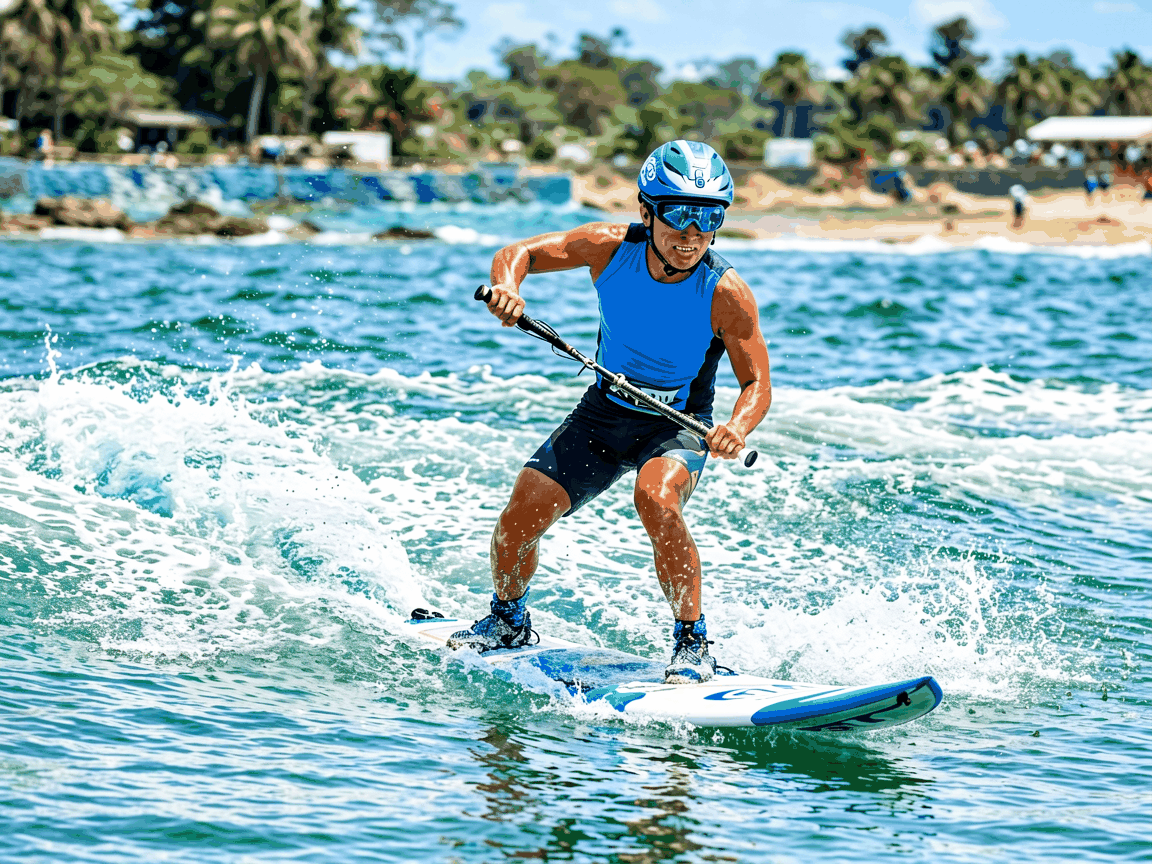
Directional control is achieved through a combination of handlebar-mounted steering and weight shifting. The handlebar connects via a cable or hydraulic linkage to a steerable nozzle or rudder system located aft of the propeller, allowing pivot angles of ±25 to 35 degrees. Throttle control operates as a twist-grip or thumb lever linked to the engine carburetor or fuel injection system, providing progressive speed regulation from idle to maximum RPM.
Safety features include a lanyard-operated kill switch that cuts ignition upon operator dislodgement, and a self-righting design in certain models where hull geometry and buoyancy distribution promote automatic rollover recovery. Foot straps or traction pads are integrated into the deck surface to maintain rider positioning during maneuvers.
Performance Characteristics
Maximum speed typically ranges from 30 to 45 km/h depending on engine power, hull drag, and rider weight (tested up to 100 kg). Acceleration from rest to planing speed occurs within 3 to 5 seconds under optimal conditions. Turning radius at half throttle averages 3 to 5 meters, influenced by rudder size and hull lateral resistance.
Operational envelope includes freshwater lakes, rivers, and sheltered coastal waters with wave heights up to 0.5 meters. Maximum recommended operating depth is generally unrestricted due to submerged propulsion, though intake blockage risk increases in shallow, vegetated, or debris-laden environments. Operating temperature range spans -10°C to 40°C, with cold-weather kits available for carburetor pre-heating in sub-zero conditions.
Material Selection and Durability Factors
Hull laminate schedules typically specify 300-450 g/m² fiberglass mat or woven roving layered with iso- or vinylester resin to achieve tensile strength between 80 and 120 MPa and flexural modulus of 4–6 GPa. Core materials exhibit compressive strength of 0.3–0.5 MPa (PVC foam) or 0.15–0.25 MPa (polyurethane), contributing to overall stiffness-to-weight ratio.
Marine-grade stainless steel (AISI 316) is used for steering cables, nozzle fittings, and exhaust components to resist chloride corrosion. Aluminum alloys (6061-T6) may appear in engine mounts or handlebar brackets, protected by anodizing or powder coating. Fuel tanks are constructed from high-density polyethylene (HDPE) or cross-linked polyethylene (PE-X) to prevent permeation and deformation under vibration.
Comparison of Common Configurations
| Parameter | Entry-Level Model | Performance Model | Commercial/Rental Model |
|---|---|---|---|
| Engine Power | 15 hp (2-stroke) | 25 hp (4-stroke) | 20 hp (4-stroke, governed) |
| Hull Material | Fiberglass/PVC foam | Carbon fiber/PVC foam | Rotomolded PE |
| Fuel Capacity | 3 L | 5 L | 6 L |
| Dry Weight | 28 kg | 22 kg | 35 kg |
| Max Speed | 30 km/h | 45 km/h | 35 km/h |
| Intended Use | Recreational | High-performance | Rental, training |
Industrial Applications and Operational Suitability
Beyond recreation, these platforms serve specialized water-based operations where agility, shallow draft, and rapid deployment are advantageous. Applications include shoreline inspection for environmental monitoring, lifeguard patrol in congested swimming zones, and aquaculture farm navigation between pens. Their low wake signature and quiet operation (relative to larger PWCs) reduce disturbance in ecologically sensitive zones.
For commercial users, the modular nature of the engine mount allows for auxiliary equipment integration—such as GPS transponders, sonar sensors, or small payload bays—within the hull’s payload capacity of 10–15 kg. Maintenance accessibility is designed into the layout, with quick-release panels providing access to the engine, fuel system, and steering linkage without hull penetration.
Quality Control and Manufacturing Considerations
Production processes emphasize vacuum bagging or resin infusion for laminate consistency, reducing void content below 2% and ensuring uniform thickness tolerance of ±1.5 mm. Post-cure thermal cycling validates resin cross-linking, particularly for polyester systems where heat deflection temperature must exceed 60°C. Hulls undergo hydrostatic testing to confirm buoyancy retention and leak integrity at 1.5x operational load.
Engine installation includes torque verification of mounting bolts to manufacturer specifications (typically 20–25 Nm) and alignment checks of the propeller shaft to prevent vibration-induced wear. Final validation involves on-water testing to verify speed, steering response, and kill switch function under simulated dismount conditions.