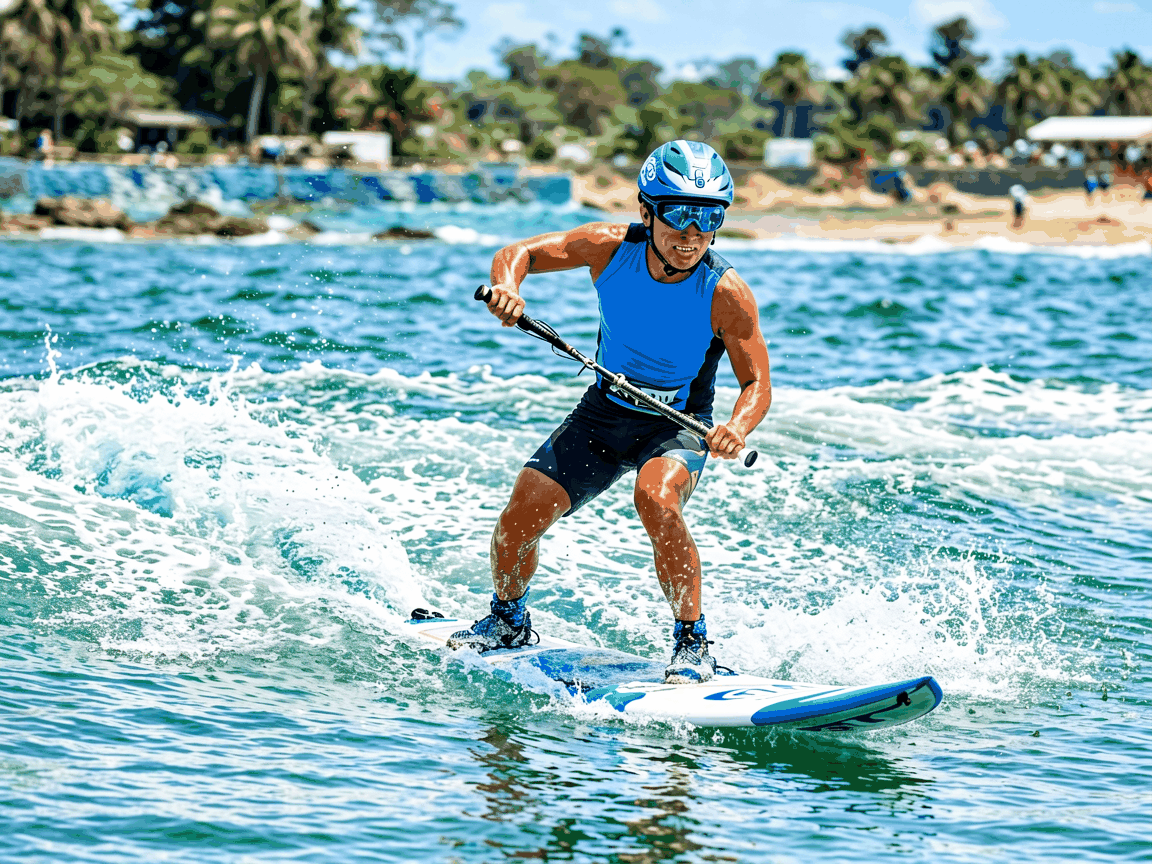
Hydrofoil Surfboard For Resort
Hydrofoil Surfboard for Resort Applications
Resort operators seeking to expand water sport offerings face unique engineering constraints: equipment must withstand prolonged saltwater exposure, require minimal daily maintenance, and deliver consistent performance across varying guest skill levels. Hydrofoil surfboards designed specifically for resort environments address these challenges through specialized material selection, modular component design, and performance tuning optimized for rental fleet durability and operational efficiency. This page details the technical characteristics that distinguish purpose-built resort hydrofoil systems from consumer-grade alternatives, focusing on measurable engineering parameters that impact lifecycle cost and guest satisfaction.
Core Structural Design Parameters
The hydrofoil system comprises three primary load-bearing components: the mast, fuselage, and front/rear wings. Mast length directly influences minimum water depth requirements and ride height stability; resort-specific models typically feature 65-75cm masts to balance shallow-water operability with sufficient lift generation for novice users. Fuselage geometry incorporates tapered cross-sections to reduce torsional flex under asymmetric loading—common when guests mount/dismount unevenly—while maintaining a minimum section modulus of 1.8 cm³ to prevent permanent deformation under repeated impact loads. Wing aspect ratios are constrained between 5.0 and 6.5 to optimize lift-to-drag ratios at low speeds (8-12 km/h) without inducing excessive yaw sensitivity during turns.
Material Selection for Marine Environments
Prolonged immersion in chlorinated or saltwater environments demands materials resistant to galvanic corrosion, UV degradation, and impact fatigue. Mast and fuselage structures utilize marine-grade 6061-T6 aluminum alloy with Type II anodization (15-25µm thickness) to achieve a minimum 500-hour salt spray resistance per ASTM B117. Wing cores employ closed-cell PVC foam with density gradients (80-120 kg/m³) to maintain buoyancy while resisting water absorption; outer skins consist of unidirectional carbon fiber prepreg laminated at 0°/90° orientations, yielding a minimum flexural strength of 450 MPa and interlaminar shear strength exceeding 8 MPa. All metal fasteners are passivated 316 stainless steel with isolated contact surfaces to prevent crevice corrosion at composite-metal interfaces.
Performance Tuning for Variable User Profiles
Resort fleets must accommodate users ranging from first-time riders to experienced enthusiasts without frequent component swaps. Adjustable shim systems integrated into the mast-fuselage junction allow pitch angle modification between -1° and +3° in 0.5° increments, enabling operators to shift the lift curve to suit different ability levels—negative pitch increases stability for beginners, while positive pitch enhances maneuverability for advanced users. Wing interchangeability is standardized via a universal 30mm square mounting interface, permitting rapid substitution of high-lift (1200 cm² area) or high-speed (800 cm² area) configurations using torque-limited fasteners preset to 4.5 Nm to prevent over-tightening damage during high-turnover operations.
Maintenance and Inspection Protocols
Operational readiness depends on predictable maintenance intervals and simplified inspection procedures. Critical wear points—including mast-track interfaces, fuselage wing mounts, and fastener threads—are designed with sacrificial wear indicators: anodized layers wear to reveal bright aluminum beneath after approximately 200 operational hours, providing visual cue for timely replacement. All threaded inserts feature helical coil designs to distribute load and resist stripping; inspection torque values are specified at 60% of proof load to accommodate cyclic fatigue. Rinse-down ports integrated into the mast base allow freshwater flushing without disassembly, reducing chloride accumulation and extending corrosion resistance intervals by 40% compared to sealed designs.
| Parameter | Typical Value | Inspection Method |
|---|---|---|
| Mast Anodization Thickness | 15-25 µm | Eddy current measurement |
| Wing Skin Flexural Strength | ≥450 MPa | Three-point bend test (ASTM D790) |
| Fastener Torque (Wing Mount) | 4.5 Nm | Calibrated torque wrench |
| Salt Spray Resistance | ≥500 hours | ASTM B117 chamber test |
| Buoyancy Retention (6-month immersion) | ≥95% initial | Hydrostatic weighing |
Operational Integration Considerations
Beyond the hydrofoil unit itself, resort deployment requires attention to storage, transport, and user interface elements. Board volume is typically maintained between 100-130 liters to ensure adequate flotation for rider recovery while allowing vertical stacking in storage racks—each unit occupies no more than 0.18 m³ when disassembled (wing removed, mast detached). Deck surfaces incorporate diamond-pattern EVA foam with 5mm thickness and 65 kg/m³ density, providing a minimum wet coefficient of friction of 0.6 to reduce slip incidents during mounting/dismounting. All labeling and instructional graphics use UV-stabilized inks laminated beneath a 0.2mm polyurethane overlay to withstand abrasion from sand, sunscreen, and repeated cleaning cycles.
Customization Pathways for Fleet Standardization
Resort operators benefit from configuration consistency across fleets to simplify training, parts inventory, and maintenance scheduling. Standardized offerings include three mast length options (65cm, 70cm, 75cm) with corresponding fuselage lengths to maintain consistent center-of-gravity positioning; wing sets are available in three lift categories (low: 900 cm², medium: 1100 cm², high: 1300 cm²) with identical mounting interfaces. Customization extends to color-coding systems—mast anodization can be specified in resort-branded hues (e.g., navy, teal, coral) without compromising coating integrity, and deck foam can be die-cut with property logos using water-resistant adhesives. All variants share identical fastener types, torque specifications, and inspection procedures to maintain uniform serviceability.
For technical consultation regarding resort hydrofoil fleet specification, including material certification documentation, performance validation data, or customized configuration proposals, please contact our engineering team.
Request Engineering Specification