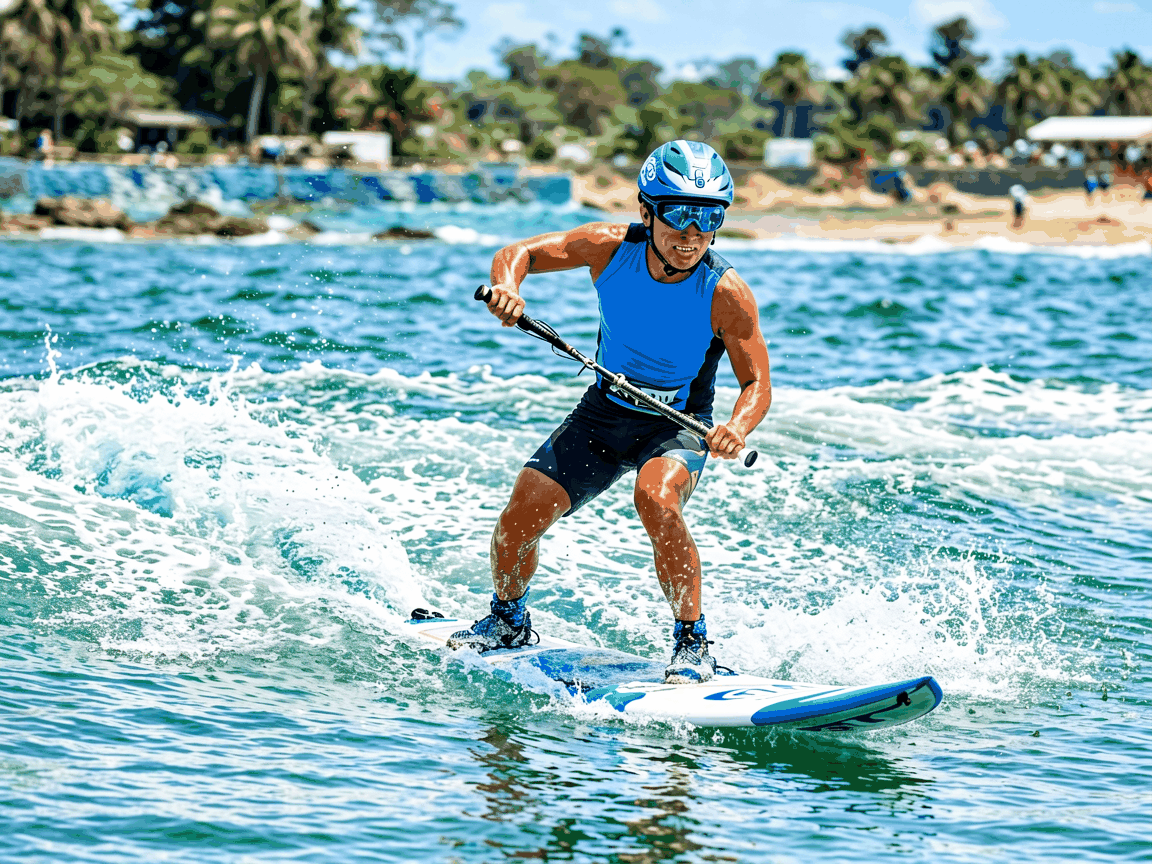
Wireless Remote Electric Hydrofoil Surfboard
Wireless Remote Electric Hydrofoil Surfboard
A wireless remote electric hydrofoil surfboard integrates an electric propulsion system with a submerged hydrofoil wing, allowing riders to glide above the water surface at controlled speeds without paddling or wave dependency. The system comprises a sealed lithium-ion battery pack, waterproof brushless motor, carbon-fiber hydrofoil mast and wings, and a handheld radio-frequency remote that transmits throttle and directional commands to an onboard receiver. Unlike traditional surfboards or electric jetboards, this design minimizes hydrodynamic drag by lifting the board clear of the water, significantly improving energy efficiency and ride smoothness at speeds between 15–35 km/h.
The wireless remote operates on a 2.4 GHz frequency hopping spread spectrum (FHSS) link, providing a reliable control range of up to 800 meters with latency under 50 milliseconds. Signal integrity is maintained through forward error correction and automatic retransmission protocols, ensuring consistent performance even in environments with moderate RF interference. The remote itself is rated IP67 for water and dust resistance, features a silicone-sealed button interface, and runs on a replaceable 3.7V Li-ion cell providing approximately 20 hours of continuous operation per charge.
Propulsion is delivered by a brushless DC motor rated between 5–15 kW peak power, depending on model, directly driving a two-bladed propeller mounted on a vertical strut beneath the board. The motor controller uses field-oriented control (FOC) to optimize torque delivery and thermal efficiency, with real-time temperature and current monitoring to prevent overheating. Power is supplied by a modular lithium-nickel-manganese-cobalt-oxide (NMC) battery pack, typically configured as 48V nominal with capacities ranging from 20Ah to 40Ah, delivering 15–60 minutes of ride time based on speed, rider weight, and water conditions.
Technical Specifications
| Parameter | Typical Value | Customization Options |
|---|---|---|
| Motor Power (Peak) | 5–15 kW | Custom winding, voltage, and KV rating per application |
| Battery Voltage | 48V nominal | 36V, 72V configurations available |
| Battery Capacity | 20–40 Ah | Modular scalability; parallel/series configurations |
| Hydrofoil Wing Span | 800–1200 mm | Aspect ratio, profile, and surface finish adjustable |
| Remote Frequency | 2.4 GHz FHSS | Alternative ISM bands upon regulatory approval |
| Control Latency | < 50 ms | Optimized for specific RF environments |
| Ingress Protection (Remote) | IP67 | IP68 available for submerged operation |
| Board Length | 1500–1800 mm | Custom molds for OEM integration |
| Maximum Speed | 35 km/h (limited by firmware) | Speed limits programmable per user profile |
| Operating Temperature | –10°C to 45°C | Extended range with thermal management upgrades |
Material Selection and Construction
The hydrofoil mast and wings are constructed from pre-impregnated carbon fiber reinforced polymer (CFRP) using aerospace-grade unidirectional and woven fabrics, cured under vacuum pressure to achieve a fiber volume fraction of approximately 60%. This results in a tensile strength exceeding 3,500 MPa and a specific stiffness (modulus-to-density ratio) over 120 GPa/(g/cm³), providing high rigidity to resist bending and torsional loads during operation while keeping the submerged assembly under 4 kg. The board hull utilizes a sandwich structure of EPS core reinforced with biaxial fiberglass and a UV-stabilized epoxy resin coating, delivering impact resistance and waterproofing without significant weight gain.
Metallic components such as motor mounts, propeller shafts, and battery housings are made from marine-grade 316L stainless steel or titanium alloy (Grade 5) depending on exposure conditions, selected for their resistance to pitting and crevice corrosion in saltwater environments. All external fasteners are either passivated stainless steel or coated with a nickel-PTFE composite to prevent galvanic coupling. Sealing interfaces between electronic enclosures and hull penetrations use dual-lip nitrile rubber O-rings with PTFE backup rings, validated for hydrostatic pressure up to 20 kPa (equivalent to 2 meters submersion).
The motor stator windings are insulated with Class H-rated polyimide enamel, capable of continuous operation at 180°C, while the rotor uses sintered neodymium iron boron (NdFeB) magnets with a nickel-copper-nickel plating to resist demagnetization and corrosion. Thermal management relies on conductive heat transfer through the motor casing to the surrounding water, eliminating the need for active cooling systems in standard configurations. Cable harnesses use tinned copper conductors with cross-linked polyethylene (XLPE) insulation and polyurethane jackets, rated for continuous flexing and saltwater immersion.
Applications and Operational Use Cases
Wireless remote electric hydrofoil surfboards are deployed in recreational water sports centers where consistent wave conditions are unreliable, enabling scheduled lessons and rental operations regardless of tide or weather. The ability to maintain precise speed control via remote input supports beginner training programs, allowing instructors to modulate thrust in real time while maintaining a safe distance from the learner. Compared to traditional tow-in methods using jet skis, this system reduces operational noise, eliminates emissions, and lowers maintenance overhead due to fewer moving parts and no internal combustion engine.
In coastal patrol and lifeguard operations, the quiet, wake-minimizing propulsion allows operators to approach swimmers or vessels in distress without creating disruptive waves that could obscure vision or endanger individuals in the water. The hydrofoil’s efficiency extends operational range per charge, enabling longer surveillance circuits between charging stations. Some models are adapted with modular payload bays for carrying lightweight emergency equipment such as communication buoys or flotation aids, secured via quick-release mounts that do not interfere with hydrodynamic performance.
Research institutions utilize these platforms as stable, low-vibration platforms for mounting sensors such as side-scan sonar, water quality probes, or underwater cameras. The absence of hull slamming and reduced cavitation noise improves data fidelity compared to conventional motorized boats. Custom firmware allows for programmable speed holding and station-keeping via GPS integration (available as an option), enabling automated transects for environmental monitoring. Payload capacity typically ranges from 5–15 kg depending on board size and hydrofoil lift characteristics.
Quality Control and Testing Philosophy
Each completed unit undergoes a standardized sequence of functional and environmental tests before shipment. Electrical systems are subjected to dielectric strength testing (1.5 kV AC for 1 minute) between live parts and enclosure, followed by insulation resistance measurement (>100 MΩ at 500 V DC). Motor performance is validated on a dynamometer test bench, confirming torque-speed curves match design specifications within ±5% across the operating range. Battery packs are checked for capacity, internal resistance, and cell balance using programmable charge/discharge cyclers, with thermal imaging performed during high-rate discharge to detect hotspots.
Hydrofoil assemblies are inspected for dimensional accuracy using coordinate measuring machines (CMM), with critical tolerances on wing angle of attack and mast straightness held to ±0.5 mm. Ultrasonic testing is performed on bonded joints between mast and fuselage to detect delamination or voids in the composite laminate. All units receive a 30-minute salt spray fog test (ASTM B117) on exposed metallic components, followed by visual inspection for signs of corrosion or coating failure. Final validation includes a wet run test in controlled water conditions, verifying remote responsiveness, motor throttle linearity, and hydrofoil lift-off speed under simulated load.
Sampling plans follow ISO 2859-1 standards, with general inspection level II and acceptable quality limit (AQL) set at 0.65 for critical defects (e.g., water ingress, propulsion failure) and 1.5 for major defects (e.g., cosmetic flaws, labeling errors). Test data is retained for traceability, linked to serial numbers via a manufacturing execution system (MES). Customers may request factory acceptance test (FAT) protocols or witness testing upon agreement, with documentation including test curves, environmental chamber logs, and inspector sign-offs.
Customization and Integration Support
Customization begins with a technical consultation to define operational requirements such as target speed, range, payload, and environmental conditions. Based on inputs, engineers select appropriate motor windings, battery configurations, and hydrofoil geometries using proprietary performance modeling tools that simulate lift, drag, and power consumption across varying water states. Hull dimensions can be adjusted to accommodate specific storage or transportation constraints, while maintaining center of gravity alignment with the hydrofoil mast to ensure stable flight characteristics.
Firmware can be tailored to implement user-specific control curves, speed limiting, geofencing, or diagnostic telemetry output via CAN bus or UART interfaces. Optional modules include GPS tracking, Bluetooth telemetry for mobile app integration, and automatic emergency shutoff triggered by tilt or immersion sensors. For OEM integrations, the propulsion unit (motor, controller, battery interface) is available as a standalone subsystem with defined mechanical and electrical interface control documents (ICDs), enabling integration into third-party hull designs.
Packaging options include shock-mounted foam inserts within double-wall corrugated cartons for standard shipment, or custom wooden crates with internal bracing for industrial or military logistics. All units are labeled with CE, FCC, and IC markings where applicable, and comply with UN 38.3 for lithium battery transportation. Documentation provided includes operation manuals, maintenance schedules, wiring diagrams, and a bill of materials (BOM) upon request. Spare parts availability is guaranteed for a minimum of 5 years from product discontinuation, including proprietary components such as motor controllers and sealed battery connectors.
For technical inquiries, customization requests, or detailed specification sheets, contact our engineering team to discuss your specific application requirements.
Request Technical Consultation