Brushless Motor Electric Surfboard
Brushless Motor Electric Surfboard
This page details the technical specifications, design considerations, and performance characteristics of brushless motor electric surfboards intended for commercial water sports operations, rental fleets, and professional training environments. The information provided supports engineering evaluation and procurement decision-making.
Core Propulsion System
The propulsion system utilizes an outrunner brushless DC motor with a Kv rating between 150 and 250 RPM/V, selected to balance torque output and top speed under variable hydrodynamic loads. Motor continuous power ratings typically range from 5 kW to 15 kW, with peak capabilities reaching 20 kW for short durations during acceleration or wave penetration. Stator laminations use 0.35mm silicon steel to minimize eddy current losses at operating frequencies between 800 Hz and 1.2 kW.
Power Supply and Energy Storage
Lithium-ion battery packs employ NMC 811 chemistry with nominal voltages between 36V and 72V, configured in series-parallel arrangements to achieve capacities from 5 kWh to 12 kWh. Battery management systems monitor cell voltage, temperature, and current with ±10mV precision and initiate thermal throttling at 60°C to prevent degradation. Pack enclosures are IP68-rated, using 6061-T6 aluminum housings with potting compound to withstand submersion pressure up to 5 meters.
Hydrodynamic Design and Materials
Board cores are constructed from closed-cell PVC foam with density between 40 kg/m³ and 60 kg/m³, providing buoyancy while resisting water absorption. Outer shells use biaxial carbon fiber weave (200 g/m²) over epoxy resin, yielding flexural modulus of 45 GPa and impact resistance exceeding 15 kJ/m². Rail thickness tapers from 25 mm at the nose to 15 mm at the tail to optimize planing surface and reduce drag coefficient below 0.28 at 25 km/h.
Control System and User Interface
Electronic speed controllers (ESCs) operate with sensorless field-oriented control, updating PWM signals at 32 kHz to maintain torque ripple under 5%. Handheld wireless remotes use 2.4 GHz FHSS technology with latency under 20 mm and range exceeding 500 meters line-of-sight. Throttle response is programmable via CAN bus, allowing adjustment of acceleration curves from linear to exponential profiles based on rider skill level.
Performance Characteristics
Typical top speed ranges from 35 km/h to 50 km/h depending on motor Kv, propeller pitch, and rider weight. Range under mixed conditions (50% throttle, choppy water) varies between 20 minutes and 45 minutes, corresponding to energy consumption of 150 Wh/km to 250 Wh/km. Launch acceleration from 0 to 20 km/h occurs in 2.8 to 4.5 seconds, verified via GPS data logging under 80 kg rider mass.
Thermal Management
Motor heat dissipation relies on conduction through the stator core to the board’s aluminum mounting plate, augmented by passive convection via exposed fins. Thermal imaging shows steady-state stator temperatures below 100°C at 10 kW continuous load in 25°C ambient water. Battery packs utilize phase-change material layers between cells to absorb transient heat spikes during rapid discharge, limiting cell temperature rise to 8°C per 1C discharge.
Maintenance and Serviceability
Motor bearings are sealed ceramic hybrid types (Si3N4 balls, 440C races) rated for 20,000 hours at 80% load. Propeller shafts use splined titanium (Ti-6Al-4V) interfaces to allow tool-free replacement in under 3 minutes. Diagnostic port access enables firmware updates and fault code retrieval via USB-C interface, with log storage for 50 hours of operational data.
Environmental and Safety Compliance
All electrical components meet IEC 60529 IP68 standards for continuous submersion. Emergency stop systems cut power within 100 ms of activation via dual-redundant hall-effect sensors. Leakage current is maintained below 0.5 mA under freshwater immersion, verified by IEC 60335-2-76 testing. Noise emissions measure under 65 dB(A) at 5 meters, minimizing disturbance to marine life and nearby operators.
Typical Applications
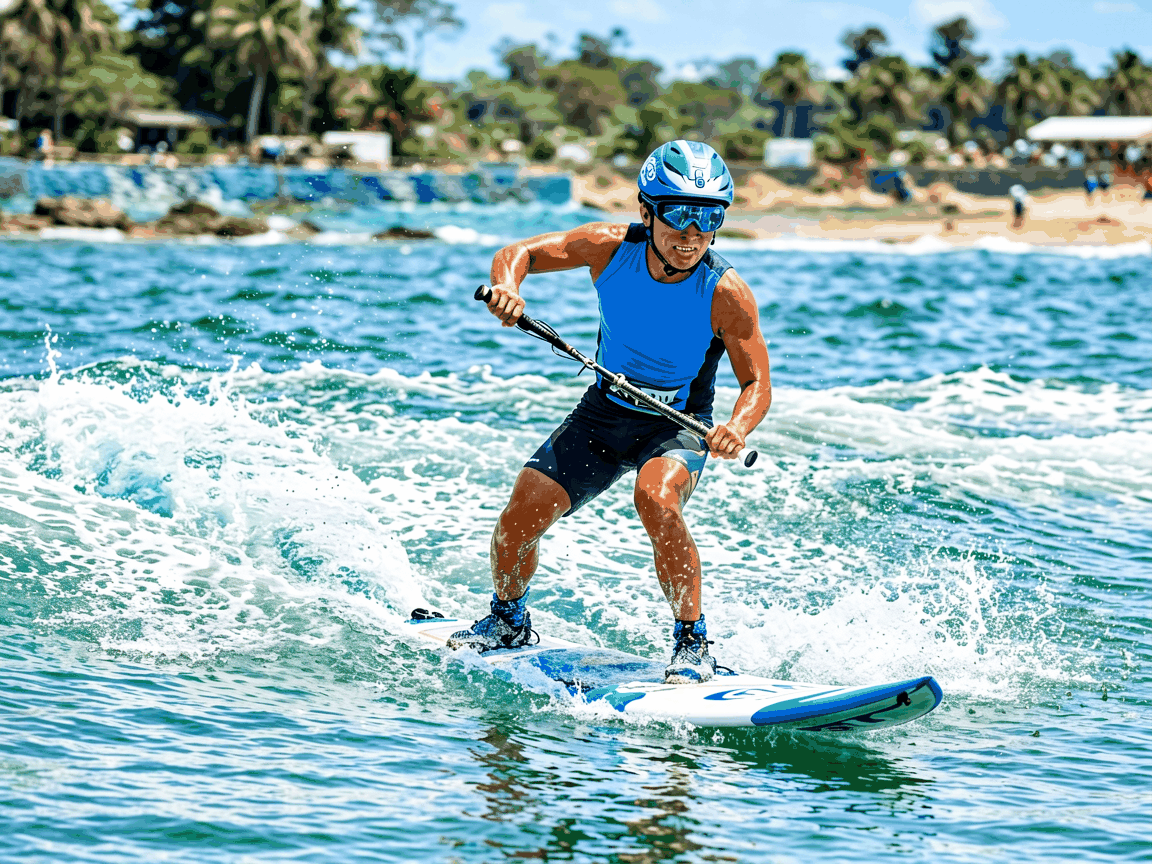
These systems are deployed in guided tour operations where consistent performance reduces guide fatigue and improves client retention. Rental facilities benefit from modular battery swaps enabling 15-minute turnaround between users. Training programs use adjustable power limits to facilitate skill progression, starting at 25% throttle for beginners and scaling to 100% for advanced maneuvers. Coastal rescue teams utilize the platform for rapid deployment in surf zones where jet skis cannot operate safely.
| Parameter | Typical Range | Unit |
|---|---|---|
| Motor Continuous Power | 5 - 15 | kW |
| Battery Capacity | 5 - 12 | kWh |
| Top Speed | 35 - 50 | km/h |
| Range (Mixed Use) | 20 - 45 | minutes |
| Charge Time (80%) | 60 - 90 | minutes |
| Operating Temperature | 0 - 40 | °C |
Customization Options
Motor Kv can be selected between 120 and 300 RPM/V to optimize for either high-torque low-speed applications or high-speed planing. Battery chemistry alternatives include LFP for extended cycle life (2000+ cycles) or NCA for higher energy density. Board dimensions are adjustable in 5 cm increments from 150 cm to 180 cm length and 50 cm to 60 cm width to accommodate different rider statures and stability requirements. Propeller pitch ranges from 100 mm to 180 mm to fine-tune acceleration versus top speed characteristics.