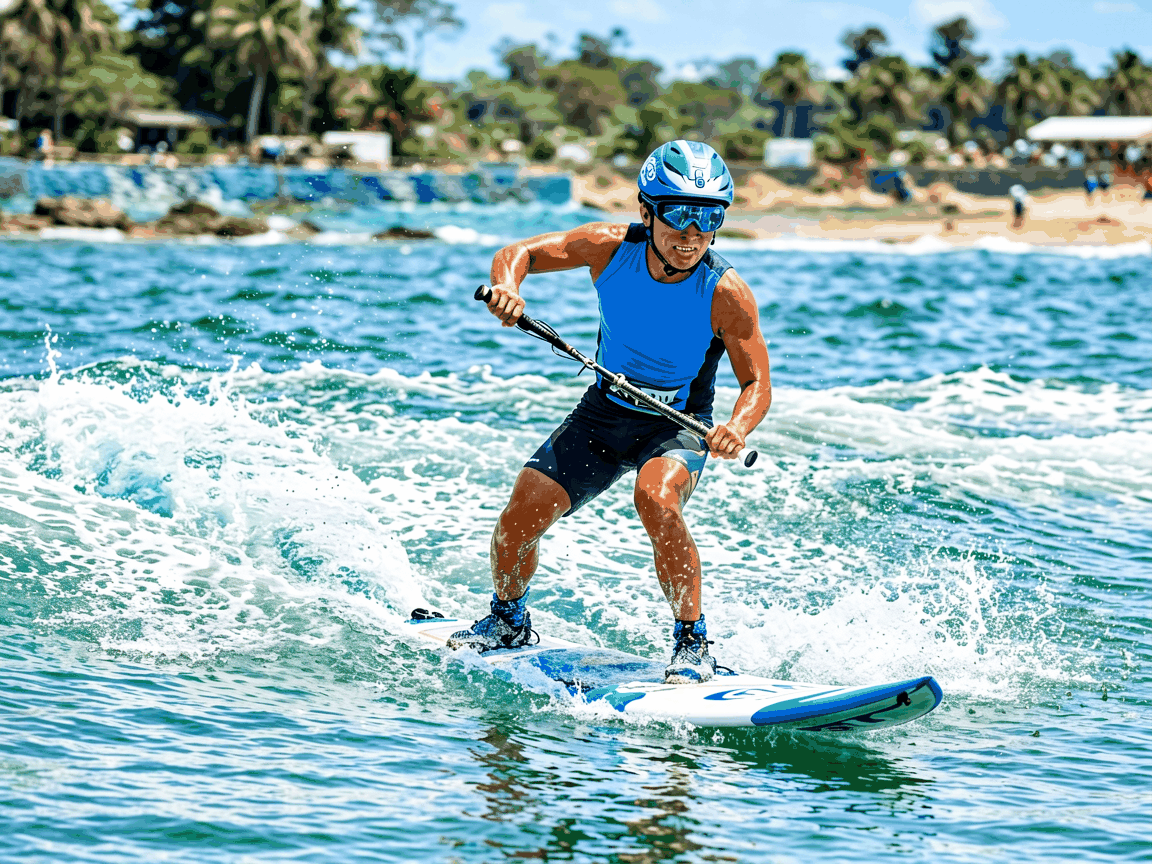
Electric Surfboard For Yacht Water Sports
Electric Surfboard for Yacht Water Sports
Electric surfboards designed for yacht integration require specific engineering considerations beyond recreational models. These systems must operate reliably in marine environments while meeting strict space, weight, and power constraints typical of superyacht tenders and garage storage. Performance parameters are defined not by maximum speed alone, but by sustained operational envelope, safety redundancy, and seamless interface with yacht auxiliary systems.
Core System Architecture
The propulsion system centers on a sealed, water-cooled permanent magnet synchronous motor (PMSM) rated for continuous duty at 10–15 kW, depending on model variant. Unlike air-cooled alternatives, water cooling maintains stable winding temperatures during extended operation, critical for yacht use where boards may be deployed consecutively over several hours. The motor is directly coupled to a composite impeller via a sealed shaft, eliminating mechanical transmission losses and potential failure points.
Energy storage uses lithium-ion battery packs with nickel-manganese-cobalt (NMC) chemistry, selected for high specific energy and thermal stability. Packs are modular, typically configured in 2–4 kWh segments, allowing yacht crews to adjust range based on expected usage patterns. Each module includes individual cell monitoring, passive balancing, and redundant thermal fuses. The entire battery enclosure achieves IP68 rating, validated through 48-hour submersion testing at 2-meter depth.
Power electronics consist of a silicon carbide (SiC) inverter mounted within the motor housing, sharing the same coolant loop. SiC switches reduce switching losses by approximately 40% compared to silicon IGBTs, improving overall system efficiency and reducing heat load on the cooling circuit. The inverter accepts DC input from the battery and provides three-phase AC to the motor, with real-time field-oriented control enabling precise torque modulation from zero to maximum RPM.
Hydrodynamic and Structural Design
The board’s hull is manufactured using vacuum-assisted resin transfer molding (VARTM) with carbon fiber-reinforced epoxy laminate. This process achieves fiber volume fractions of 55–60%, resulting in a tensile strength exceeding 800 MPa and flexural modulus above 70 GPa. Nominal board thickness ranges from 100–130 mm, tapering toward the nose and tail to minimize pitch resistance. Core material is closed-cell PVC foam, density 60 kg/m³, providing shear stiffness while contributing negligible weight.
Bottom contours feature a double concave design with integrated channels to manage spray and improve planing efficiency at speeds between 20–35 km/h. The concave depth varies linearly from 8 mm at the feet to 2 mm at the rails, promoting lateral stability without increasing drag. Rail geometry uses a soft-hard transition: rounded upper 60% for comfort during knee starts, sharp lower 40% for clean water release during planing. All external surfaces receive a UV-stabilized, abrasion-resistant polyurethane topcoat, rated for 500+ hours of saltwater exposure per ASTM G154.
Foot strap assemblies are constructed from 316L stainless steel brackets with thermoplastic polyurethane (TPU) inserts, allowing quick-release adjustment while resisting galvanic corrosion. Straps themselves use UV-stabilized nylon webbing with breaking strength >22 kN. Optional bindings are available for wake-style riding, featuring adjustable heel cups and torsion bars made from glass-filled polyamide.
Mounting interfaces for yacht integration include recessed D-rings (grade 8.8 titanium) at four points, enabling secure lashing to deck storage systems or swim platforms. Optional quick-release mounts conform to NATO STANAG 4695 standards, allowing tool-free installation/removal in under 30 seconds. Weight distribution is carefully balanced; the battery pack is positioned slightly aft of center to offset motor mass, resulting in a longitudinal center of gravity within 15 mm of the geometric center.
Performance and Operational Parameters
Typical continuous power output ranges from 8–12 kW, yielding a top speed of 38–45 km/h depending on rider weight and water conditions. Acceleration from 0 to 30 km/h occurs in 4–6 seconds under full throttle. Range varies significantly with usage pattern: intermittent operation (30 seconds on, 90 seconds off) yields 45–60 minutes of effective ride time per 4 kWh module, while continuous cruising at 25 km/h reduces this to 20–25 minutes. These values assume neutral buoyancy trim and calm water conditions.
Charging is conducted via onboard yacht systems or dedicated shore stations. Input voltage accepts 100–240 VAC, 50/60 Hz, with power factor correction achieving >0.95 efficiency. Charging profiles follow IEC 62133 standards: constant current (0.5C) to 80% state of charge, then constant voltage to 100%. Full recharge of a 4 kWh module takes approximately 3.5 hours at 1.1 kW input. Fast charging options (up to 3.3 kW) are available but reduce cycle life by an estimated 15–20% based on Arrhenius modeling of lithium-ion degradation.
Environmental operating limits are defined as follows: water temperature range 2–35°C, maximum wave height 1.2 m for safe operation, and maximum wind speed 25 km/h. The system includes ingress protection for all connectors (IP68) and features automatic power reduction if internal temperatures exceed 80°C in the motor or 60°C in the battery compartment. Riders receive haptic feedback via handlebar-mounted actuators when approaching thermal or voltage limits.
Integration with Yacht Systems
Electric surfboards for yacht use are designed to interface with existing marine electrical and monitoring infrastructure. The battery management system (BMS) provides CAN bus output (SAE J1939 protocol) transmitting state of charge, voltage, current, temperature, and fault codes. This allows integration with yacht-wide monitoring systems such as CZone, Navico, or Maretron, enabling crew to check board status from the bridge or via mobile apps.
Optional shore power interfaces include Marinco-style inlets mounted flush in the swim platform, allowing direct charging without removing the board. These inlets feature automatic shut-off valves and seawater-rated covers. For yachts with DC microgrids, direct DC-DC converters (input: 24–48 VDC, output: 400 VDC nominal) are available, eliminating the need for AC inversion and improving overall charging efficiency by approximately 12%.
Storage solutions account for the board’s dimensions (typically 1800–2000 mm L × 600–650 mm W × 150–180 mm H) and weight (28–35 kg depending on configuration). Custom cradles use aluminum alloy 6061-T6 frames with neoprene padding and adjustable straps. Some designs incorporate drainage channels and passive ventilation to prevent moisture accumulation during long-term storage. Impact resistance is validated through drop testing from 1.2 m onto HDPE simulant, representing dock or deck contact.
Safety and Redundancy Features
Multiple independent safety layers are implemented to mitigate risks associated with high-energy electrical systems in aquatic environments. The primary disconnect is a magnetic kill switch lanyard, which opens the main circuit within 100 ms of detachment. Secondary protection includes dual Hall-effect current sensors monitoring for leakage; if imbalance exceeds 30 mA, the system isolates the battery within 20 ms. All high-voltage components are encapsulated in electrically insulating epoxy (dielectric strength >18 kV/mm).
Buoyancy is inherently positive; even with full battery load, the board displaces sufficient water to support 150% of its maximum rated weight. Additional flotation chambers are molded into the nose and tail sections, providing redundant flotation in case of hull compromise. These chambers are vented via hydrophobic membranes (e.g., Gore-Tex) to equalize pressure while preventing water ingress.
Software safeguards include overcurrent protection (tripping at 150% of rated current), overvoltage limits (cutoff at 4.2V/cell), and undervoltage protection (shutdown at 2.8V/cell to prevent lithium plating). The BMS logs all events with timestamps, enabling post-incident analysis. Remote diagnostics are available via Bluetooth 5.0 LE, allowing manufacturers to review fault histories during warranty claims.
Maintenance and Serviceability
Routine maintenance focuses on inspection, cleaning, and firmware updates. After each use, the board should be rinsed with fresh water to remove salt deposits, particularly around connectors and motor seals. Seal integrity is checked visually for signs of swelling, cracking, or deformation; replacement intervals are typically 24–36 months under normal use. The impeller and intake grate should be cleared of debris (seaweed, fishing line) to prevent motor overload.
Battery maintenance involves periodic capacity testing and impedance tracking. Manufacturers recommend annual full-cycle capacity tests to assess health; replacement is advised when usable capacity falls below 80% of original. Firmware updates are delivered via USB-C port or wirelessly over Bluetooth, improving motor control algorithms, adding safety features, or optimizing charging curves. No user-serviceable internal components exist beyond external seals and straps.
Warranty terms typically cover 24 months for the battery (pro-rated after 12 months) and 36 months for the motor and electronics. Coverage excludes damage from improper storage, impact with fixed objects, or use outside specified environmental conditions. Service networks are established in major yachting hubs (Mediterranean, Caribbean, Southeast Asia), with spare parts stocked locally for critical items such as seals, connectors, and control units.
Comparison: Electric vs. Internal Combustion Surfboard Tend
| Parameter | Electric Surfboard | Gasoline-Powered Jet Ski |
|---|---|---|
| Operating Noise | < 65 dB(A) at 50% throttle | 80–90 dB(A) at cruise |
| Emissions (Local) | Zero | CO, NOx, hydrocarbons |
| Vibration (Rider) | Minimal (motor only) | Significant (engine + pump) |
| Maintenance Interval | Seal check every 24 months | Oil change every 50 hrs |
| Storage Footprint | Vertical or flat, no fuel | Requires fuel tank ventilation |
| Instant Torque | Available at 0 RPM | Requires engine spool |
This comparison highlights operational advantages relevant to yacht environments: reduced noise preserves onboard tranquility, zero emissions comply with increasingly strict marina regulations, and simplified maintenance reduces crew burden. The instant torque characteristic improves responsiveness in tight spaces such as swim platforms or crowded anchorages.
Customization Options for Yacht Applications
Manufacturers offer tiered customization levels to align with specific yacht requirements. Basic options include choice of battery capacity (2, 4, or 6 kWh modules), motor power rating (8 kW, 12 kW, or 15 kW), and color scheme (typically white, gray, or navy with non-slip deck pads). Intermediate customization adds bespoke graphics, tailored foot strap positioning, and alternative fin configurations (single center, twin, or quad).
Advanced integration services involve modifying the board’s physical interface to match existing yacht storage systems. This may include adjusting overall dimensions to fit specific garage envelopes, adding reinforced mounting points for hydraulic lifts, or integrating the board’s BMS with the yacht’s power management system for load shedding coordination. Hydrodynamic tuning is also available; for example, increasing rocker for better performance in choppy conditions common in certain cruising grounds.
All customization requests require submission of the yacht’s general arrangement plans, storage compartment details, and electrical system specifications. Engineers perform interference checks and validate that proposed modifications do not compromise structural integrity or safety margins. Lead times for fully customized units typically range from 12–18 weeks, depending on complexity and component availability.