Electric Surfboard With Handle
Electric Surfboard with Handle
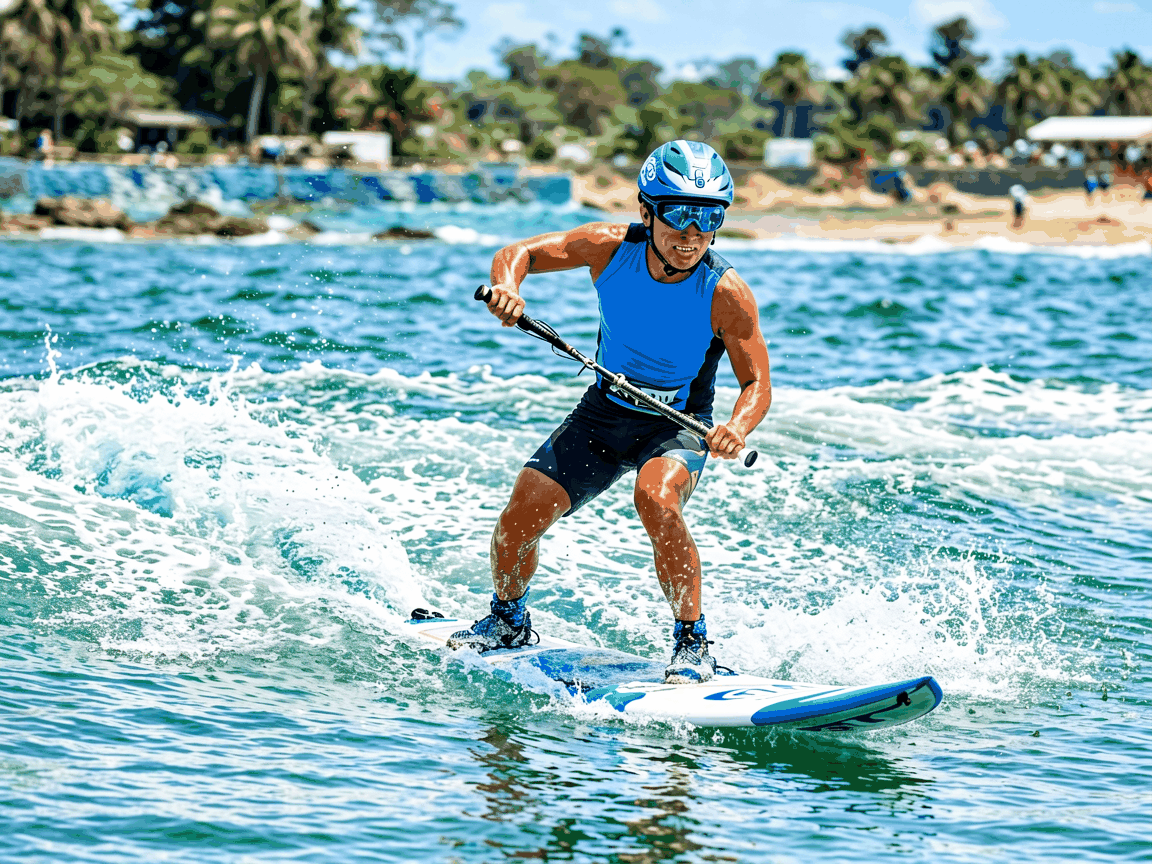
An electric surfboard with handle integrates a sealed electric propulsion system, a rigid or semi-rigid board platform, and an ergonomic handgrip to enable rider-controlled thrust and directional stability in open water. The handle serves as both a primary control interface and a safety tether point, allowing the rider to modulate speed, initiate turns, and maintain balance without relying solely on foot pressure or body positioning. This configuration differs from conventional electric surfboards by centralizing input commands at the upper body, reducing lower-limb fatigue and improving accessibility for riders with varying skill levels or physical constraints. The system is designed for recreational use in coastal, lake, or river environments where wave conditions are mild to moderate, and where regulatory compliance with personal watercraft standards applies.
Core components include a waterproof lithium-ion battery pack, a brushless DC motor mounted within a hydrodynamically faired pod, an electronic speed controller (ESC) with throttle input from the handle, and a composite or molded polymer board shell reinforced with longitudinal stringers. The handle is typically constructed from marine-grade aluminum or reinforced thermoplastic, featuring a non-slip grip surface, integrated throttle trigger, and a kill-switch lanyard attachment point. Sealing integrity is achieved through IP68-rated enclosures for electronics, dynamic shaft seals for the motor propeller shaft, and gasketed battery compartments. Buoyancy is engineered to maintain positive flotation even when flooded, with inherent stability derived from a wide, flat planing hull shape and low center of gravity from submerged ballast.
Technical Specifications
| Parameter | Typical Value | Notes |
|---|---|---|
| Board Length | 1800–2200 mm | Optimized for maneuverability and transport; custom lengths available |
| Board Width | 600–750 mm | Width affects stability; wider models for beginners |
| Thickness (at center) | 100–130 mm | Includes core, reinforcement layers, and motor pod fairing |
| Motor Power (Continuous) | 3–5 kW | Peak power up to 7 kW for 10–15 second bursts |
| Battery Capacity | 2.0–3.5 kWh | Lithium-ion NMC or LFP chemistry; determines runtime |
| Runtime (Typical Use) | 20–40 minutes | Dependent on throttle profile, rider weight, water conditions |
| Maximum Speed | 35–45 km/h | Limited by motor KV, propeller pitch, and ESC software governance |
| Charge Time (0–80%) | 60–90 minutes | Using Level 2 AC charger (220V, 16A); DC fast charging optional |
| Total Weight (with battery) | 20–28 kg | Influenced by battery size, board material, and motor housing |
| Maximum Rider Weight | 120 kg | Verified through static and dynamic load testing |
| Ingress Protection (Electronics) | IP68 | Battery, ESC, and motor controller sealed to withstand submersion |
| Handle Material | 6061-T6 aluminum or glass-filled PA6 | Anodized or UV-stabilized finish for corrosion resistance |
Design and Engineering Considerations
The handle’s mechanical interface is engineered to transmit both tensile and torsional loads during operation. It connects to the board via a stainless steel pivot pin or polymer bushing system that allows limited angular movement (typically ±15°) to accommodate rider motion while maintaining cable integrity for throttle and kill-switch wiring. Internal routing of electrical conductors through the handle shaft prevents abrasion and entanglement, with strain relief boots at both ends. The grip surface is overmolded with thermoplastic elastomer (TPE) to provide traction when wet and to dampen vibration transmitted from the motor and water impact.
Motor placement is critical for hydrodynamic performance and trim. The propulsion pod is recessed into the board’s tail section, aligned with the longitudinal axis to minimize yaw moment. Propeller clearance is maintained at least 20 mm above the board’s bottom surface to prevent contact with debris or substrate in shallow water. The pod includes a skeg or finlet to improve tracking and reduce cavitation-induced vibration. Weight distribution is biased slightly rearward (60/40 rear/front) to promote planing attitude at speed, with the battery pack positioned low and central to lower the center of gravity.
Thermal management employs passive conduction through the motor housing to the surrounding water, supplemented by heat-conductive pads linking the ESC to internal aluminum plates. No active cooling (e.g., water jackets or fans) is used in standard models to preserve sealing integrity. Battery temperature is monitored via internal NTC sensors, with software-imposed power derating above 55°C to prevent cell degradation. Ambient operating temperature range is typically -10°C to 40°C, though performance may reduce in extreme cold due to battery chemistry limitations.
Applications and Use Cases
Electric surfboards with handles are particularly suited for instruction and rental operations in protected waterways. The handle provides instructors with a physical means to guide or retrieve a student board without entering the water, enhancing safety during beginner lessons. Rental fleets benefit from reduced learning curves—novice riders can achieve planing and basic control within 10–15 minutes of instruction, compared to 30+ minutes for handleless models requiring mastery of weight-shift steering. This increases customer throughput and reduces equipment damage from falls or mishandling.
Adaptive recreation programs utilize the handle as a support point for riders with limited lower-body mobility or balance impairments. The ability to control speed and direction via upper-body input allows participation in water sports that would otherwise be inaccessible. Some models incorporate optional forearm crutches or thigh straps that interface with the handle system, enabling customized support configurations. Rescue and patrol agencies have evaluated these devices for rapid deployment in near-shore scenarios, where the handle allows officers to tow the board while swimming or to maintain control during victim approach.
In coastal tourism zones with strict noise or emissions regulations, electric surfboards offer a zero-emission alternative to gasoline-powered personal watercraft. Their quiet operation (typically <65 dB at 50 ft) and lack of exhaust or fuel spillage make them compliant with marine protected area guidelines. The handle’s presence also aids in regulatory compliance by providing a clear, visible control point that distinguishes the device from uncontrolled flotation aids, facilitating enforcement of speed zones or no-wake areas.
Customization Options
Board geometry can be adjusted to target specific user profiles or environmental conditions. Wider tails (up to 800 mm) increase stability for heavier riders or choppy water, while narrower profiles (550 mm) improve agility for experienced users in flat water. Rocker (bottom curvature) is variable—more pronounced rocker prevents pearling in waves, while flatter rocker enhances glide and efficiency in calm conditions. Length adjustments affect transportability and turning radius; boards under 2000 mm are preferred for urban rental fleets with limited storage.
Motor and battery systems are modular, allowing power and runtime trade-offs. A 3 kW motor with 2.0 kWh battery suits lightweight riders and short-session rentals, delivering ~25 minutes runtime. A 5 kW motor with 3.5 kWh battery supports heavier users, wave riding, or extended patrols, offering up to 40 minutes at moderate throttle. Motor KV (RPM/V) and propeller diameter/pitch are selected as a pair to optimize thrust efficiency at the target operating speed—common pairings range from 400–600 KV with 140–180 mm diameter props.
Handle design varies by application. Standard models feature a straight, cylindrical grip with integrated throttle trigger. Ergonomic variants include a contoured palm swell and index-finger throttle lever for reduced hand fatigue during prolonged use. Some versions incorporate a quick-release mechanism allowing the handle to be detached for storage or transport, secured by a marine-grade pin with safety tether. Handle length is adjustable in 25 mm increments via telescoping sections or interchangeable extensions, accommodating riders of different stature or preferred stance width.
Additional options include integrated GPS speedometers, LED navigation lights (front white, rear red), and removable fin systems for tracking enhancement. Battery chargers range from standard 120V/220V AC units to 12V DC vehicle-mounted units for field operations. All customizations maintain IP68 sealing for electronic components and are subject to validation testing for water ingress, impact resistance, and UV stability.
Quality Control and Testing
Each unit undergoes a multi-stage validation process prior to shipment. Initial inspection verifies dimensional accuracy of the board shell, handle alignment, and motor pod fitment using coordinate measuring machines (CMM) or laser scanners. Electrical continuity and isolation resistance are tested at 500 VDC between live circuits and grounded parts, with minimum acceptable values of 10 MΩ. Battery packs are subjected to capacity verification at 0.2C discharge rate and checked for cell balance (<20 mV variance).
Hydrostatic testing confirms sealing integrity: the assembled unit (without battery) is submerged to 1.0 meter depth for 30 minutes with no internal moisture detection via internal humidity sensors or visual inspection. Post-test, the unit is dried and rechecked for electrical insulation. Dynamic testing includes a 30-minute endurance run at 75% throttle in fresh water, monitoring motor temperature, ESC performance, and battery voltage drop. Vibration resistance is validated via random vibration profile (10–500 Hz, 0.04 g²/Hz) simulating ocean chop, with post-test functional checks.
Final validation includes a functional sea trial: acceleration to top speed, turning radius measurement (target <3.5 m at 20 km/h), and kill-switch lanyard activation test (motor cutoff within 0.5 seconds of handle detachment). All data is logged and retained for traceability. Units failing any test are quarantined for root cause analysis—common issues include seal misalignment, wire chafing at pivot points, or inverter thermal shutdown. Only units passing 100% of tests receive final packaging and certification labeling.
Packaging and Logistics
Standard packaging consists of a double-wall corrugated cardboard box with die-cut foam inserts designed to immobilize the board, handle, battery, and charger. The board is positioned deck-down to protect the finish, with cutouts accommodating the motor pod and fins. The handle is secured in a dedicated cradle to prevent bending stress on the shaft. Battery and charger are placed in separate compartments with anti-static padding. Internal dimensions are typically 2200L × 750W × 200H mm for a 2100 mm board, optimized for palletization (two units per standard 1200×1000 mm pallet).
External packaging includes UV-resistant polyethylene stretch wrap and corner protectors to mitigate corner damage during transit. Each box is labeled with handling instructions: “This Side Up,” “Keep Dry,” and “Fragile – Electronic Components Inside.” For international shipments, the battery is classified as UN 3480, Lithium Ion Batteries, requiring Class 9 hazardous materials documentation and packaging compliant with IMDG/IATA regulations. A material safety data sheet (MSDS) and battery test summary (UN 38.3) are included with each shipment.
Optional packaging upgrades include reusable hard cases made from rotomolded polyethylene with custom foam interiors, preferred by rental operators for repeated use. These cases feature pressure equalization valves, stainless steel latches, and wheel kits for mobility. Marking options include silk-screened logos or QR codes linking to user manuals and warranty registration. Lead time for standard packaging is typically 2–3 weeks; custom cases or branded inserts may extend lead time by 1–2 weeks depending on tooling availability.
To discuss technical specifications, customization options, or request a quotation for electric surfboards with handle, please contact our engineering team. Provide your intended use case, expected operating environment, and any required certifications (e.g., CE, UL, FCC) to receive a tailored response.