Motorized Surfboard For Sale
Motorized Surfboard for Sale
A motorized surfboard integrates electric propulsion with hydrodynamic design to enable wave-independent water sports. Unlike traditional surfboards that rely on paddling or wave energy, these systems use battery-powered thrust to generate forward motion, allowing operation in flat water, lakes, rivers, or coastal areas without consistent swells. This technology shifts the performance dependency from environmental conditions to onboard power systems, making it suitable for training, recreation, and commercial use in varied aquatic environments.
Core Propulsion System Specifications
The propulsion unit typically consists of a sealed brushless DC motor mounted within a hydrodynamically faired pod, connected to a jet pump or propeller via a stainless steel shaft. Motor power ratings commonly range from 5 kW to 15 kW peak, delivering thrust between 150 N and 400 N depending on propeller design and voltage input. Efficiency is optimized through computational fluid dynamics (CFD)-refined nozzle geometry, minimizing cavitation and maximizing propulsive efficiency—often exceeding 65% under typical operating conditions. Thermal management relies on passive conduction through the board’s structure and active water cooling channels around the motor housing.
Energy Storage and Power Delivery
Lithium-ion battery packs, usually configured as 48V to 72V systems with capacities between 20 Ah and 40 Ah, provide energy storage. These packs are enclosed in IP68-rated, marine-grade aluminum or reinforced polymer housings with internal cell balancing, overcurrent protection, and thermal monitoring. Typical energy density ranges from 150 Wh/kg to 200 Wh/kg, enabling runtime between 20 and 45 minutes at moderate throttle, depending on rider weight, water conditions, and speed profile. Charging is conducted via dedicated marine-grade connectors, with full recharge times ranging from 2 to 4 hours using standard Level 2 chargers; fast-charge options may reduce this to under 90 minutes with compatible infrastructure.
Board Construction and Hydrodynamics
The board structure combines a foam core (typically EPS or polyurethane) with composite skins made of carbon fiber, fiberglass, or hybrid laminates. Skin layup schedules are engineered to withstand torsional loads from motor torque and impact forces during operation, with typical flexural modulus values between 8 GPa and 15 GPa for carbon-reinforced variants. Bottom contours often feature concave channels or stepped hulls to improve planing efficiency and reduce drag at speeds exceeding 25 km/h. Rail designs balance stability and maneuverability, with volume distribution calculated to support rider weights from 50 kg to 120 kg while maintaining adequate freeboard to prevent water ingestion into the propulsion unit.
Control System and User Interface
Operation is managed via a handheld wireless throttle/trigger unit communicating with the board’s electronic speed controller (ESC) through a proprietary 2.4 GHz protocol with frequency hopping for interference resistance. The ESC interprets throttle input and modulates power delivery using pulse-width modulation (PWM), incorporating safety features such as low-voltage cutoff, over-temperature throttling, and automatic motor disengagement upon signal loss. Some systems include LCD displays on the handheld unit showing real-time metrics: battery state of charge, current draw, speed (via GPS or paddle-wheel sensor), and fault codes. Waterproof connectors and conformal-coated PCBs ensure reliability in wet environments.
Performance Characteristics and Operational Envelope
Top speed is primarily governed by motor KV rating, propeller pitch, and voltage, with typical ranges between 30 km/h and 50 km/h for consumer-oriented models. Acceleration from 0 to 25 km/h generally occurs within 3 to 5 seconds, depending on thrust-to-weight ratio. Maneuverability is influenced by board length (commonly 1500 mm to 1800 mm), width (500 mm to 650 mm), and rocker profile—shorter boards with increased rocker offer tighter turning radii but reduced straight-line stability. Maximum operating depth is limited by snorkel intake design (if present) or jet pump clearance, usually allowing operation in water as shallow as 0.6 m without risk of debris ingestion, though performance degrades in vegetated or turbulent conditions.
Material Selection and Environmental Resistance
Marine-grade materials are selected to resist corrosion, UV degradation, and impact. Fasteners are typically stainless steel (A4/316) or titanium, while seals use nitrile rubber or EPDM for compatibility with salt and freshwater. Exterior coatings often involve UV-stabilized polyurethane or epoxy-based finishes with salt-spray resistance exceeding 500 hours in ASTM B117 testing. Buoyancy foam is closed-cell to prevent water absorption, maintaining structural integrity even if the outer skin is compromised. All electrical penetrations utilize potting or compression glands to maintain IP68 integrity under prolonged submersion and thermal cycling.
Typical Applications and Use Cases
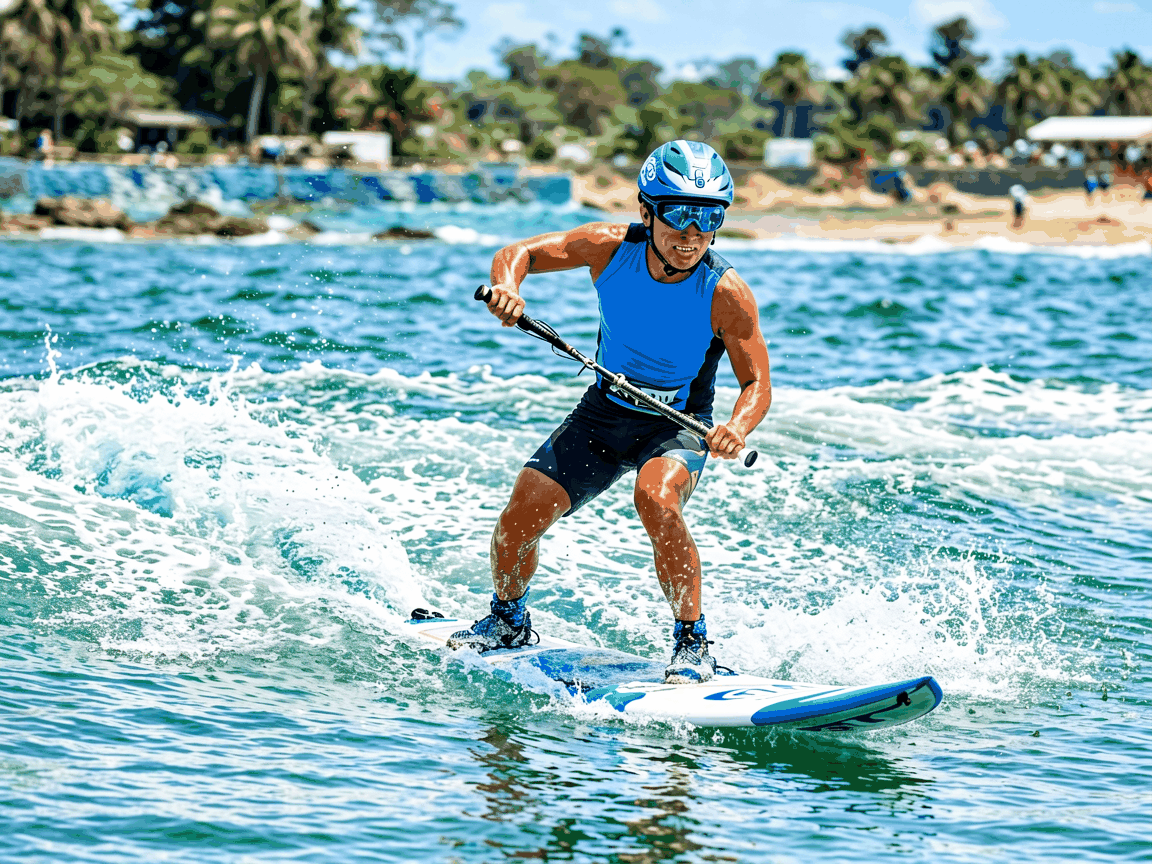
Motorized surfboards serve diverse sectors beyond recreation. In lifeguard and rescue operations, they enable rapid deployment to distressed swimmers without requiring a vessel or jet ski, reducing response time in nearshore environments. Coastal patrol units use them for silent, low-wake surveillance in ecologically sensitive zones where motorized boats are restricted. Water sports schools employ them for beginner instruction, allowing students to focus on balance and wave positioning without the fatigue of paddling. Film production teams utilize them for dynamic water-level shots in flat water locations, eliminating the need for boats or cranes. Additionally, they support aquatic fitness programs and adaptive sports initiatives by providing powered assistance for users with limited upper-body strength.
Comparison of Common Configurations
| Parameter | Entry-Level Model | Performance Model | Commercial/Rescue Model |
|---|---|---|---|
| Motor Power (Peak) | 5–8 kW | 10–12 kW | 12–15 kW |
| Battery Capacity | 20–25 Ah (48V) | 30–35 Ah (60V) | 35–40 Ah (72V) |
| Typical Runtime | 20–25 min | 25–35 min | 30–45 min |
| Top Speed | 30–35 km/h | 40–45 km/h | 45–50 km/h |
| Board Length | 1500–1600 mm | 1600–1700 mm | 1700–1800 mm |
| Target User Weight | 50–90 kg | 70–110 kg | 80–120 kg |
Quality Assurance and Testing Protocols
Manufacturing validation includes hydrostatic pressure testing of sealed compartments to 1.5x rated depth, thermal cycling between -10°C and 50°C to assess seal and bond integrity, and vibration testing simulating transportation and operational loads. Each unit undergoes functional verification: throttle response latency under 100 ms, emergency cutoff activation within 200 ms of signal loss, and battery isolation resistance >100 MΩ. Water ingress testing follows IP68 standards—submersion at 1.5 m for 30 minutes with post-test insulation and functional checks. Final acceptance includes a operational test run verifying speed, steering responsiveness, and system telemetry logging under load.