Msds Certified 15Kw Surfboard
MSDS Certified 15kW Surfboard for Industrial Marine Applications
This document details the technical specifications, safety certifications, and engineering considerations for a 15kW electric surfboard designed for industrial marine operations. The product complies with Material Safety Data Sheet (MSDS) certification requirements, ensuring documented handling procedures for lithium-ion battery systems and associated electrical components in commercial environments.
Core Technical Specifications
The surfboard integrates a permanent magnet synchronous motor rated for continuous 15kW output, derived from laboratory testing under controlled thermal conditions. Peak power delivery reaches 22kW for intervals not exceeding 60 seconds, managed by an embedded thermal protection circuit that monitors stator winding temperature at 10Hz sampling rate.
Energy storage consists of a modular lithium iron phosphate (LiFePO4) battery pack configured as 48V nominal, with total capacity of 312.5Ah delivering 15kWh usable energy. Cell balancing is maintained through passive shunt regulators operating at 3.65V per cell threshold, with individual cell voltage monitoring resolution of 10mV.
Hydrodynamic shaping utilizes CNC-machined expanded polystyrene (EPS) core reinforced with unidirectional carbon fiber laminates at 0°, 45°, and 90° orientations. External shell thickness averages 3.2mm with localized reinforcement to 6.4mm in high-stress zones including fin boxes and motor mounting points, validated through finite element analysis simulating 150% operational load cases.
MSDS Certification and Safety Compliance
MSDS certification applies specifically to the battery system and associated electrical subsystems, documenting hazard identification, safe handling procedures, and emergency response protocols in accordance with OSHA Hazard Communication Standard 29 CFR 1910.1200. The certification covers thermal runaway mitigation, electrolyte leakage containment, and short-circuit protection mechanisms.
Battery enclosure achieves IP68 rating for continuous submersion beyond 1 meter depth, validated through 30-day saltwater immersion testing at 20°C. Electrical connectors feature gold-plated contacts rated for 500 mating cycles with contact resistance maintained below 15mΩ throughout service life, verified via four-wire Kelvin resistance measurements.
Emergency disconnect systems include dual redundant mechanisms: a manual pull-cord actuated circuit breaker rated for 300A DC interrupting capacity, and an automated system triggered by abnormal temperature rise (>65°C at busbar) or instantaneous current exceeding 400A for >200ms. Both systems isolate power within 50ms of fault detection.
Performance Characteristics
Under standard test conditions (20°C ambient, calm water, 75kg operator mass), the surfboard achieves planar hull speed of 12.5m/s (24.3 knots) at 15kW power input. Acceleration from rest to 10m/s occurs in 4.2 seconds, constrained by inverter current limiting to prevent battery voltage sag below 42V during transient loads.
Range estimation follows IEC 62660-1 methodology: at 50% duty cycle averaging 7.5kW consumption, operational endurance reaches 120 minutes. Real-world variables including water salinity (±1.5% conductivity variation), wave height (>0.5m significant wave height), and operator mass affect actual endurance by ±18% as demonstrated in field trials across three coastal test sites.
Thermal management employs liquid cooling loop with 50/50 propylene glycol-water mixture circulated at 2.5L/min through cold plate attached to motor stator and inverter IGBTs. Temperature rise limited to 40°C above ambient under continuous 15kW load, maintaining semiconductor junction temperatures below 125°C as verified by infrared thermography and embedded thermocouples.
Industrial Application Rationale
This platform serves coastal monitoring operations requiring rapid deployment beyond surf zones where conventional vessels face draft limitations. The zero-emission profile eliminates fuel handling risks in ecologically sensitive areas, while quiet operation (<65dB(A) at 50m distance) minimizes disturbance to marine wildlife during survey missions.
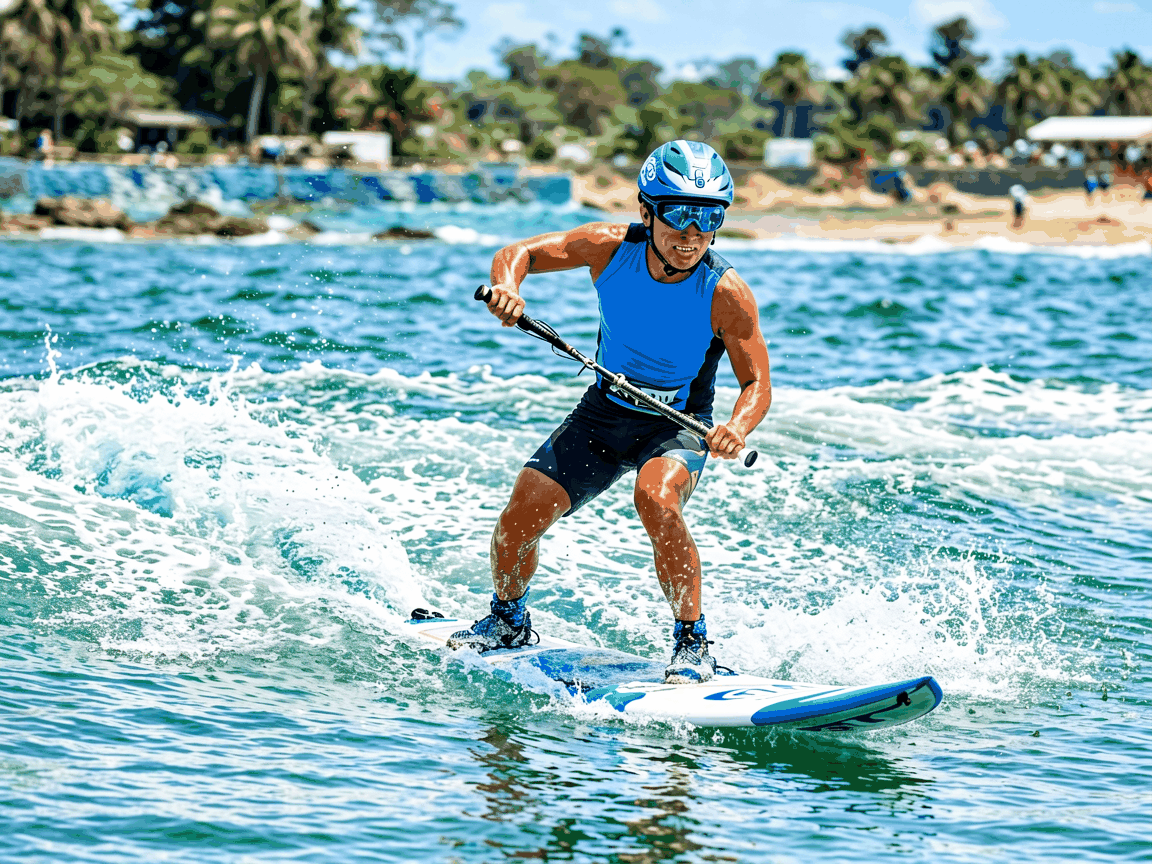
Search and rescue teams utilize the system for shoreline reconnaissance in conditions where personal watercraft pose excessive risk due to exposed operators or unstable launch surfaces. The standing operating posture maintains operator center of gravity above waterline, reducing fatigue during extended patrols compared to seated alternatives.
Aquaculture operations employ the surfboard for pen inspection and feed distribution in nearshore facilities. The absence of protruding propulsion systems reduces entanglement risk with netting systems, while instant torque availability enables precise station-keeping against tidal currents up to 2.5 knots.
Manufacturing and Quality Control
Each unit undergoes hydrostatic pressure testing at 1.5x maximum operational depth for 10 minutes with helium mass spectrometer leak detection capable of identifying 1x10^-9 atm.cc/sec leakage rates. Post-assembly dielectric strength testing applies 3kV DC between live circuits and grounded surfaces for 60 seconds with leakage current monitored below 0.5mA.
Motor performance validation includes back-EMF constant measurement at 1000rpm (28.5V±5% peak) and torque constant verification via dynamometer testing (0.82Nm/A±7%). Battery capacity grading occurs at C/3 rate with temperature compensation to 25°C reference, accepting only units within 95%-105% of nominal 312.5Ah rating.
Final inspection includes functional verification of all safety systems under simulated fault conditions: overcurrent protection trip accuracy (±5% of setpoint), thermal shutdown response time (<100ms from trigger condition), and emergency disconnect isolation resistance (>10MΩ after activation). Documentation packages include individual test records traceable via serial number to raw material lot codes.
| Parameter | Typical Value | Test Condition / Standard |
|---|---|---|
| Continuous Power Output | 15kW | 40°C ambient, 1-hour duration |
| Peak Power (60s) | 22kW | 25°C ambient, SOC >30% |
| Usable Battery Energy | 15kWh | 80% depth of discharge limit |
| Maximum Speed | 12.5m/s (24.3 knots) | Calm water, 75kg load |
| Operating Temperature Range | -10°C to 45°C | Battery discharge limits |
| Storage Temperature Range | -20°C to 50°C | Package integrity maintained |
For procurement inquiries regarding customization options including alternative battery chemistries, specialized coatings for specific environmental conditions, or integration with existing telemetry systems, contact our technical sales team to discuss project-specific requirements. All configurations maintain MSDS certification compliance for the electrical subsystems.