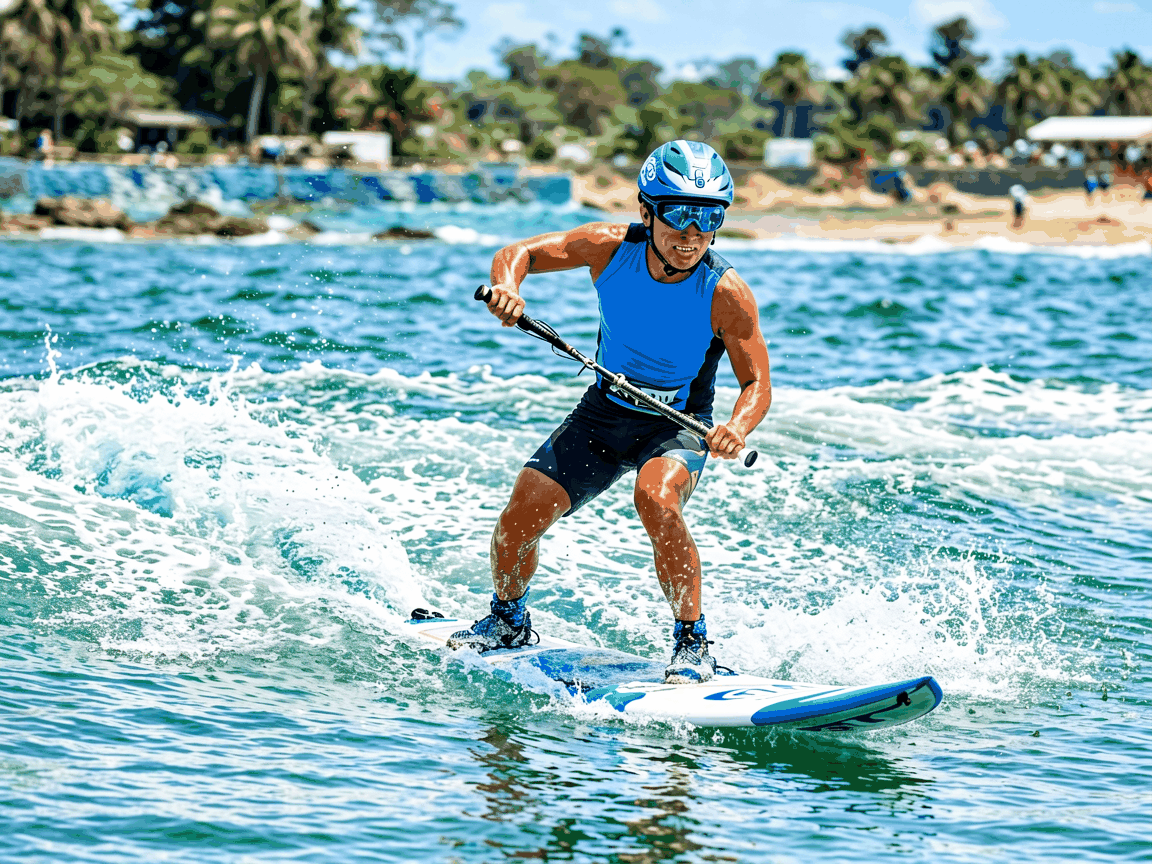
Wireless Remote Electric Surfboard
Wireless Remote Electric Surfboard
A wireless remote electric surfboard combines battery-powered propulsion with radio-frequency control to enable rider maneuverability without physical tethering. This configuration allows for hands-free operation during wave riding or flat-water transit, relying on sealed electronic systems to maintain performance in marine environments. The design prioritizes hydrodynamic efficiency, power-to-weight ratio, and environmental sealing to ensure consistent thrust delivery and rider safety.
Core Propulsion System
The propulsion unit consists of a brushless DC motor integrated with a sealed jet pump or propeller system, delivering thrust through water displacement rather than fin-based actuation. Motor continuous power ratings typically range from 5 kW to 15 kW, with peak outputs reaching 20 kW for short-duration acceleration. Torque delivery is managed via electronic speed controllers (ESCs) that modulate current based on throttle input from the wireless remote, enabling smooth power curves and regenerative braking capabilities.
Motor cooling is achieved through direct water jackets or heat exchanger paths routed within the board’s internal cavity, eliminating the need for external cooling fans. Winding insulation uses Class H-rated materials (180°C thermal endurance) to withstand prolonged operation at elevated temperatures. Shaft seals employ double-lip designs with PTFE coatings to prevent saltwater ingress while maintaining low rotational friction.
Thrust vectoring is fixed in most models, relying on board tilt and rider weight shift for directional control. Some variants incorporate adjustable nozzle systems (±15° yaw) actuated by servo motors, allowing finer steering response at low speeds. Jet pump designs favor axial-flow configurations with stator vanes to reduce swirl losses, achieving propulsive efficiencies between 28% and 35% under typical operating conditions.
Energy Storage and Management
Lithium-ion battery packs serve as the primary energy source, configured in series-parallel arrangements to meet voltage and capacity demands. Nominal pack voltages range from 48 V to 80 V, with capacities between 30 Ah and 60 Ah, yielding total energy storage of 1.4 kWh to 4.8 kWh. Cell chemistry typically uses NMC or LFP formulations, selected for thermal stability and cycle life exceeding 500 cycles at 80% depth of discharge.
Battery enclosures are constructed from marine-grade aluminum or carbon-fiber-reinforced polymer, featuring multi-layer sealing: primary O-ring gaskets, secondary potting compounds, and tertiary conformal coatings on PCB assemblies. Internal cell spacing incorporates thermal barriers and phase-change materials to mitigate propagation risk during thermal runaway events. Management systems monitor cell voltage, temperature, and current balance at 100 Hz intervals, triggering shutdown if any parameter exceeds predefined thresholds.
Charging is conducted via isolated conductive ports rated for IP68 ingress protection, supporting both AC (110–240 V) and DC fast-charging inputs. Charge controllers implement CC-CV algorithms with cell-level balancing, limiting charge rates to 1C for LFP and 0.7C for NMC chemistries to preserve longevity. Full recharge times range from 2.5 hours (fast charge) to 6 hours (standard AC), depending on pack size and charger output.
Wireless Control System
The wireless remote operates on 2.4 GHz ISM band using frequency-hopping spread spectrum (FHSS) or direct-sequence spread spectrum (DSSS) modulation to resist interference from Wi-Fi, Bluetooth, and marine radar systems. Transmission power is limited to 10 mW (10 dBm) to comply with FCC and CE regulations, providing reliable control ranges of 300–500 meters over open water. Latency between remote input and motor response remains under 50 milliseconds, ensuring immediate throttle and directional feedback.
Remote housings are rated IP67, constructed from UV-stabilized polycarbonate with overmolded thermoplastic elastomer grips for wet-hand operation. Controls include a thumb-operated throttle lever (Hall-effect sensor, 0–100% range), a trigger for emergency cut-off, and mode-select buttons for adjusting power profiles (e.g., Eco, Sport, Race). Battery life exceeds 20 hours of intermittent use, powered by internal 18650 cells rechargeable via USB-C.
On-board receivers feature dual-antenna diversity systems with RSSI monitoring to maintain link integrity. Fail-safe protocols trigger motor cutoff if signal loss exceeds 200 milliseconds, preventing uncontrolled operation. Pairing uses AES-128 encryption to prevent unauthorized interception, with unique keys exchanged during initial setup.
Board Construction and Hydrodynamics
The board’s outer shell utilizes sandwich composite construction: outer layers of carbon fiber or fiberglass reinforced epoxy, surrounding a core of closed-cell PVC foam or honeycomb aluminum. This configuration achieves flexural stiffness between 800 N·m² and 1500 N·m² while keeping total mass under 35 kg (including battery and motor). Surface finishes apply UV-resistant gel coats or polyurethane topcoats to resist delamination and salt-induced degradation.
Hull shaping follows planing hull principles, featuring a flat to slightly concave bottom surface with pronounced rocker (20–30 mm rise at nose) to prevent pearling during takeoff. Rail contours incorporate soft-chine transitions to reduce spray and improve stability during rail-to-rail pumping. Volume distribution targets 120–180 liters, providing sufficient buoyancy for rider weights up to 120 kg while maintaining maneuverability.
Bottom contours may include concave channels or vented tunnels to enhance planing efficiency and reduce suction drag at speeds above 15 km/h. Fin systems are typically absent; directional stability relies on hull geometry and rider input. Some models feature retractable hydrofoils (not to be confused with e-foils) for lift-assisted planing at speeds exceeding 25 km/h, reducing wetted surface area and improving battery range.
Performance Characteristics
Maximum speed varies with motor power, hull drag, and rider weight, typically ranging from 35 km/h (22 mph) for entry-level models to 55 km/h (34 mph) for high-performance variants. Acceleration from 0 to 20 km/h occurs in 2.5–4.0 seconds, dependent on thrust-to-weight ratio and ESC response curves. Range under mixed-use conditions (50% throttle, choppy water) spans 15–25 kilometers, decreasing to 10–15 km at sustained high-speed operation.
Gradeability (ability to maintain speed against current or headwind) is influenced by thrust reserve and propeller cavitation limits. Boards with jet pump systems maintain thrust up to 10 km/h headwinds, while propeller-driven variants experience performance degradation beyond 15 km/h due to ventilating blades. Turning radius at 30 km/h averages 8–12 meters, adjustable via rider lean and, where available, nozzle vectoring.
Noise emissions remain below 75 dB(A) at 5 meters distance, primarily originating from motor cooling water expulsion and cavitation at the jet nozzle. Vibration transmission to the rider is minimized through elastic motor mounts and decoupled battery trays, keeping hand-arm vibration levels under 2.5 m/s² RMS during operation.
Environmental and Operational Considerations
All external fasteners use marine-grade stainless steel (A4-316) or titanium to resist galvanic corrosion in saline environments. Bonding between dissimilar materials employs insulating layers or sealants to prevent electrochemical potential differences. Deck pads incorporate closed-cell EVA foam with diamond-groove patterning for water drainage and grip retention when wet.
Operational temperature ranges span -10°C to 45°C for storage and 0°C to 40°C for active use, limited by battery chemistry and LCD visibility in the remote. Saltwater exposure necessitates post-use rinsing with fresh water and periodic inspection of seals, connectors, and anode sacrificial zones (if present). Storage recommends 50% state of charge for lithium packs, maintained in climate-controlled environments to minimize capacity fade.
Transportation complies with UN 3480 for lithium-ion batteries, requiring Class 9 labeling and specialized packaging for air shipment. Ground and sea freight follow IMDG and IATA regulations, with batteries disconnected and terminals insulated. Boards are typically shipped in custom foam inserts within double-wall cardboard or reusable plastic cases, protecting against impact and puncture.
Applications and Use Cases
Recreational users employ wireless remote electric surfboards for lagoon exploration, river surfing, and coastal transit where wave access is limited or inconsistent. The absence of a tether allows riders to navigate congested swimming zones or marina approaches safely, reducing entanglement risks associated with leash-dependent boards. Instructors utilize the steady thrust delivery for beginner training, enabling students to focus on balance and stance without paddling fatigue.
Rescue and patrol agencies adopt these platforms for rapid response in shallow water, debris fields, or ice-covered zones where traditional boats face accessibility constraints. The low acoustic signature and minimal wake permit discreet approach to distressed swimmers or wildlife monitoring zones. Some models integrate GPS tracking and emergency beacon compatibility, enhancing situational awareness during extended operations.
Commercial applications include guided tour operations in calm inland waters, where silent operation preserves natural ambiance and reduces disturbance to aquatic life. Rental fleets benefit from simplified logistics—no fuel handling, minimal maintenance intervals, and standardized charging infrastructure. Fleet managers monitor usage via Bluetooth telemetry (optional), tracking battery cycles, distance traveled, and motor runtime for preventive scheduling.
Technical Specifications
| Parameter | Typical Range | Notes |
|---|---|---|
| Motor Continuous Power | 5–15 kW | Peak up to 20 kW |
| Battery Voltage | 48–80 V DC | Nominal pack |
| Battery Capacity | 30–60 Ah | Cell-dependent |
| Total Energy Storage | 1.4–4.8 kWh | Usable ~80–90% |
| Maximum Speed | 35–55 km/h | Rider & condition dependent |
| Range (Mixed Use) | 15–25 km | 50% throttle, chop |
| Charge Time (Standard AC) | 4–6 hours | CC-CV, 10A max |
| Control Latency | <50 ms | Remote to motor |
| Operating Temperature | 0–40°C | Ambient water/air |
| Total Mass (Ready-to-Ride) | 28–35 kg | Includes battery |
Specifications reflect typical production variants; actual values depend on motor size, battery chemistry, hull design, and optional features. Custom configurations are available upon request to meet specific performance, endurance, or environmental requirements.
Customization Options
Motor selection allows trade-offs between torque density and top speed, with options ranging from outrunner configurations (high torque, lower RPM) to innrunner designs (high RPM, reduced torque). Propeller or jet pump diameter can be adjusted to match hull displacement and target cruising speed, influencing both thrust efficiency and cavitation threshold.
Battery packs support alternative chemistries (LFP for enhanced cycle life, NMC for higher energy density) and scalable capacity modules to extend range or reduce weight. Voltage platforms can be shifted between 48 V, 60 V, and 80 V systems to align with existing charging infrastructure or motor compatibility.
Hull geometry can be tailored for specific applications: increased rocker for surf-oriented models, flatter bottoms for touring variants, or reinforced hulls for commercial use. Deck layouts support alternate pad configurations, foot strap inserts, or gear mounts for accessories such as action cameras, sonar transducers, or small cargo nets.
Wireless remotes support ergonomic adjustments (grip size, trigger tension) and optional displays showing real-time speed, battery state, and distance traveled. Firmware updates enable new riding modes, throttle response curves, or geofencing capabilities via over-the-air (OTA) delivery when cellular modules are integrated.
Quality Assurance and Testing
Each unit undergoes hydrostatic pressure testing of sealed enclosures to 1.5 times rated depth (typically 1.5 m submersion equivalent) to validate seal integrity under dynamic load. Motor insulation resistance is measured at 500 V DC, requiring minimum values of 100 MΩ between windings and ground. Continuity checks verify proper grounding of all exposed conductive parts to prevent shock hazards.
Radio frequency compliance is confirmed through FCC Part 15 and CE RED testing, verifying emissions fall within permitted bands and spurious outputs remain below regulatory thresholds. Receiver sensitivity is assessed at -90 dBm to ensure reliable operation at maximum range. Remote-to-board pairing success rates are validated across 100+ cycles under varying interference conditions.
Performance validation includes thrust benchmarking via load cell dynamometers, speed verification using GPS-aided Doppler logs, and range testing under standardized duty cycles (e.g., 30 seconds on, 90 seconds off at 75% throttle). Thermal imaging monitors motor and battery temperatures during extended runs to confirm cooling efficacy. Salt spray exposure follows ASTM B117 for 500 hours, with post-test inspection for corrosion, delamination, or seal degradation.
Final inspection confirms proper labeling, user manual inclusion, and accessory completeness (charger, remote, fins if applicable, repair kit). Packaging drop tests simulate handling stresses to ensure unit arrives undamaged. Documentation includes CE/UKCA conformity declarations, battery safety data sheets, and user guides available in multiple languages.
Maintenance and Serviceability
Routine maintenance focuses on external cleaning, seal inspection, and firmware updates. After each use, the board should be rinsed with fresh water to remove salt, sand, and organic deposits. Seals around the motor shaft, battery lid, and charging port require visual checks for cracks, deformation, or salt crystallization; lubrication with silicone-based compounds is recommended quarterly.
Battery health monitoring is accessible via the wireless remote or optional smartphone app, displaying cell voltages, temperature trends, and cycle count. Balancing procedures are managed automatically by the BMS, though manual equalization charges may be advised after prolonged storage. Motor bearings are sealed for life; replacement requires disassembly of the propulsion unit and is typically scheduled every 500–800 operating hours.
Control system troubleshooting begins with verifying remote battery charge, re-pairing devices, and checking for fault codes via LED indicators. Water ingress alerts trigger diagnostic modes that isolate affected subsystems. Spare parts availability includes proprietary motor controllers, battery management boards, and remote housings, supported through authorized service centers with turnaround times under 10 business days for standard components.
Firmware updates are delivered via USB-C on the remote or wireless OTA when enabled, improving throttle linearity, adding safety features, or expanding diagnostic capabilities. Version control ensures backward compatibility with older hardware revisions. Service logs are retained digitally for warranty tracking and failure analysis.