China Jetfly Gas Surfboard
China Jetfly Gas Surfboard
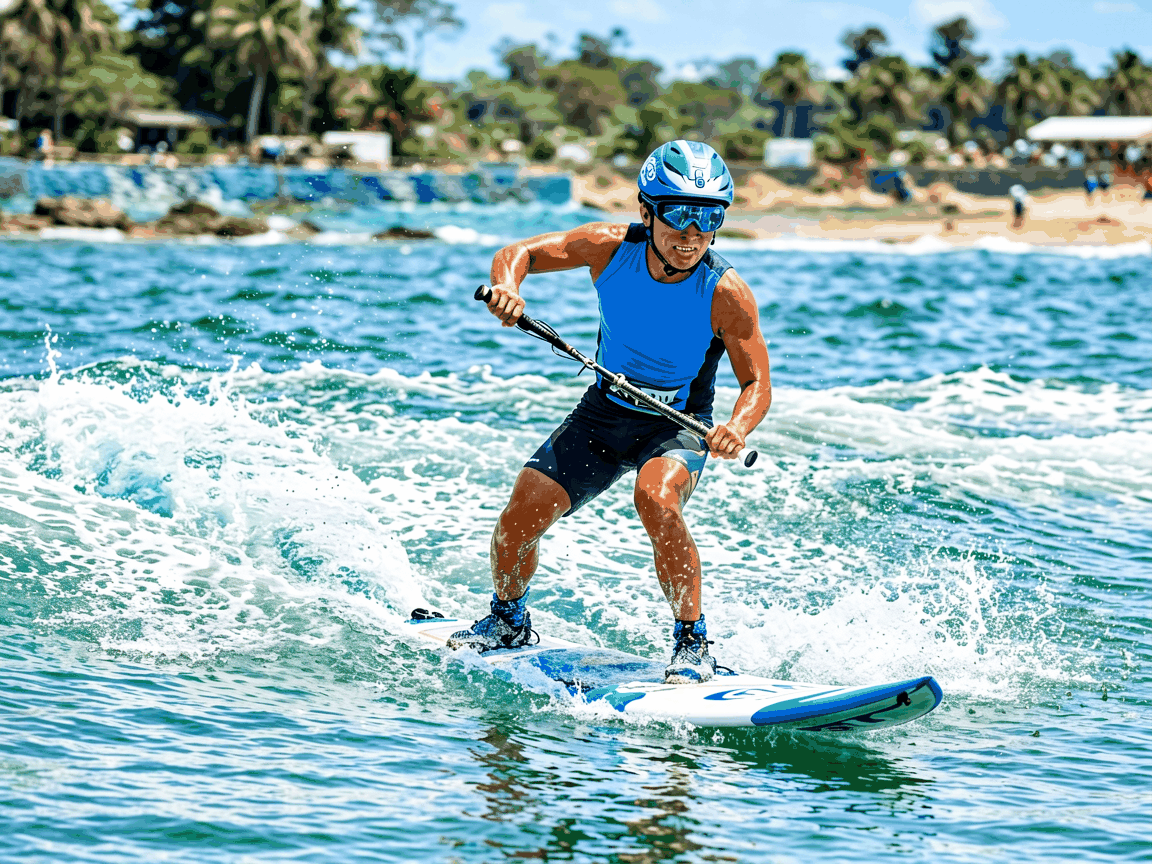
The China Jetfly gas surfboard is a motorized personal watercraft designed for recreational and light commercial use on calm to moderately choppy inland and coastal waters. It integrates a compact two-stroke gasoline engine with a hydrodynamic hull to provide thrust-independent propulsion, allowing riders to move across water surfaces without relying on wave action or paddling.
Unlike electric surfboards that depend on battery capacity and charging infrastructure, the gas-powered variant offers extended operational duration limited only by fuel supply, making it suitable for rental operations, guided tours, and private use where recharging is impractical. The system is engineered for simplicity in operation and maintenance, targeting users who prioritize range and readiness over silent operation.
Core Propulsion System
The propulsion unit consists of a single-cylinder, air-cooled two-stroke gasoline engine displacing approximately 49cc, producing a rated output of 3.5 kW (4.7 hp) at 7,500 RPM. Power is transmitted via a centrifugal clutch to a sealed, stainless steel impeller housed within a vented jet tunnel, generating a water jet exit velocity of roughly 18–22 m/s depending on throttle position and load conditions.
Fuel delivery is managed by a diaphragm-type carburetor with adjustable idle and main jets, calibrated for consistent performance across altitudes up to 1,500 meters. The system includes a manual primer bulb and a translucent 1.2-liter fuel tank positioned above the engine for gravity feed, providing approximately 60–90 minutes of continuous operation at moderate throttle.
Exhaust is routed through a water-cooled stainless steel muffler integrated into the hull’s rear section, reducing noise emissions to approximately 82 dB(A) at 3 meters under partial load while preventing saltwater corrosion in marine environments. Ignition is handled by a CDI unit with a sealed spark plug, designed for reliable starting in humid conditions.
Hull Design and Hydrodynamics
The hull is constructed from rotomolded high-density polyethylene (HDPE) with a nominal wall thickness of 8 mm, forming a monocoque structure that resists impact, UV degradation, and osmotic blistering. The shape features a moderate rocker profile (120 mm nose lift, 80 mm tail lift) and a flat-bottomed midsection to balance stability, planing efficiency, and maneuverability in water depths as shallow as 0.6 meters.
Two parallel sponsons extend laterally from the hull’s midline, each measuring 180 mm in width and 30 mm in height, increasing lateral resistance to reduce drifting during turns and improving stability at speeds above 15 km/h. The jet intake is positioned 50 mm aft of the bow, protected by a removable polypropylene grate with 10 mm bar spacing to prevent debris ingestion while maintaining 85% open area for flow.
Steering is achieved through a handlebar-linked nozzle vectoring system capable of ±20 degrees of articulation, allowing the rider to pivot the jet stream for directional control without rudders or fins. The system uses stainless steel cables and nylon-lined housings to resist stretching and corrosion, with adjustment points at both the handlebar and nozzle base for cable tension tuning.
Materials and Construction
The primary hull material is virgin HDPE resin (Melt Flow Index 0.22–0.28 g/10 min) selected for its combination of impact strength (≥35 kJ/m² Notched Izod), environmental stress crack resistance (ESCR > 500 hours), and low moisture absorption (<0.01% after 24-hour immersion). Color pigments are UV-stabilized and dispersed during rotomolding to ensure consistent hue throughout the wall thickness, preventing surface fading.
Metal components exposed to water or spray are predominantly marine-grade AISI 316 stainless steel, including the impeller shaft, jet nozzle housing, exhaust tube, and steering linkage. Fasteners use nylon-insert lock nuts or thread-locking adhesive to prevent loosening from vibration. The engine mounting brackets are fabricated from powder-coated aluminum alloy (A380) to reduce weight while maintaining corrosion resistance.
The fuel tank and fuel lines are made from ethanol-resistant polyethylene (PE-RT) rated for continuous contact with gasoline blends up to E10. All rubber seals and gaskets use nitrile-butadiene rubber (NBR) with a Shore A hardness of 60–70, chosen for fuel compatibility and compression set resistance under thermal cycling.
Operational Characteristics
Under typical operating conditions (75 kg rider, flat water, 20°C ambient temperature), the Jetfly gas surfboard achieves a planing speed of 25–30 km/h at 70% throttle, with a maximum speed of approximately 38 km/h under full throttle and optimal trim. Acceleration from rest to planing speed occurs in 4–6 seconds, depending on rider positioning and weight distribution.
Turning radius at 20 km/h averages 3.5 meters when using aggressive body lean and nozzle vectoring, decreasing to 2.2 meters with simultaneous throttle reduction and sharp handlebar input. The craft maintains directional stability at speeds above 12 km/h due to the combined effect of the sponsons, hull width (750 mm), and jet thrust vectoring, minimizing porpoising or fishtailing in calm conditions.
The craft is designed for operation in significant wave heights up to 0.3 meters; beyond this, periodic bow submersion and ventilation of the jet intake may occur, requiring rider adjustment to maintain airflow and thrust efficiency. Maximum recommended operating depth is 2.5 meters to avoid hull stress from pressure differentials, though operation in shallower water is unrestricted as long as the intake grate remains submerged.
Maintenance and Serviceability
Routine maintenance includes pre- and post-use inspection of the jet intake grate for debris, verification of fuel line integrity, and checking throttle cable freeplay (target: 2–3 mm at the handlebar). After each use in saltwater, the hull, jet tunnel, and exhaust system should be flushed with fresh water for 2–3 minutes to prevent chloride accumulation.
Engine maintenance follows standard two-stroke protocols: spark plug inspection and replacement every 25 hours, air filter cleaning every 10 hours (or more frequently in dusty environments), and decarbonization of the exhaust port and piston crown every 50 hours using a non-abrasive solvent. Fuel mixture ratio is fixed at 50:1 (gasoline to 2T oil) using ISO-L-EGD certified oil; deviation risks inadequate lubrication or excessive smoke.
The jet pump assembly is designed for removal without hull disassembly—four stainless steel bolts secure the pump housing to the hull, allowing access to the impeller and wear ring for inspection or replacement. Wear ring clearance is factory-set at 0.3–0.5 mm; replacement is advised if clearance exceeds 1.0 mm to maintain efficiency. All service points are accessible with basic hand tools (metric sockets, screwdrivers, pliers).
| Component | Inspection Interval | Service Action |
|---|---|---|
| Jet intake grate | Pre- and post-use | Remove debris; inspect for cracks |
| Fuel lines and connections | Every 5 hours | Check for leaks, hardening, or swelling |
| Spark plug | Every 25 hours | Inspect electrode gap (0.6–0.7 mm); replace if worn |
| Impeller and wear ring | Every 50 hours | Measure clearance; replace if >1.0 mm |
| Throttle cable | Every 10 hours | Check freeplay; lubricate if stiff |
| Hull exterior | Monthly | Wash with mild detergent; inspect for stress whitening |
Applications and Use Cases
The Jetfly gas surfboard is commonly deployed in guided coastal tour operations where launch sites lack electrical infrastructure and operational duration exceeds the typical 30–45 minute limit of battery-powered alternatives. Rental fleets in inland lakes and slow-moving rivers benefit from the rapid refueling capability, enabling high turnover rates with minimal downtime between users.
Rescue and patrol units in lifeguard services or coastal monitoring programs utilize the craft for rapid response in zones inaccessible to larger vessels, leveraging its shallow draft and quick acceleration to reach distressed swimmers or inspect shoreline hazards. The high visibility color options (safety orange, yellow, white) and optional mounting points for strobe lights or flags enhance conspicuity during operations.
Private owners use the craft for recreational exploration of estuaries, lagoons, and archipelagos where wave-dependent surfing is impractical. Its portability—facilitated by integrated bow and stern handles and a dry weight of approximately 28 kg—allows transport on standard roof racks or in pickup truck beds without specialized trailers.
Customization and Configuration Options
Standard configurations include a fixed handlebar height (850 mm above hull deck), a right-hand throttle twist grip, and a kill switch mounted on the left handlebar grip. Optional upgrades consist of an extended-length steering cable (+150 mm) for taller riders, a dual-throttle lever system for adaptive control, and a reinforced transom plate for tow-line attachment.
Hull color can be specified from a palette of six UV-stabilized HDPE compounds (white, safety yellow, safety orange, blue, gray, and charcoal), with custom color matching available for orders exceeding 50 units. Additional features such as a removable storage pod (3.5L capacity, mounted aft of the engine) or a padded knee strap system can be integrated during molding to avoid post-production drilling.
For commercial operators, optional instrumentation includes a tachometer (0–8,000 RPM), hour meter, and low-fuel warning light, all wired to a sealed switch panel mounted on the handlebar bracket. These additions do not alter the hull structure or propulsion system and are installed using existing mounting bosses.