Gas Powered Surfboard For Adults And Water Sports
Gas Powered Surfboard for Adults and Water Sports
Gas powered surfboards represent a distinct category of personal watercraft that combines internal combustion propulsion with surfboard form factors to enable extended range and higher sustained speeds than electric alternatives. Designed for adult riders seeking performance in open water conditions, these systems prioritize power-to-weight ratio, fuel efficiency, and hydrodynamic stability. Understanding their engineering trade-offs is essential for evaluating suitability in recreational, training, or light commercial water sports applications.
Core Propulsion System Architecture
The propulsion unit typically integrates a two-stroke or four-stroke gasoline engine ranging from 15 to 25 horsepower, mounted internally within a reinforced composite hull to maintain a low center of gravity. Power is transmitted via a sealed drive shaft to a steerable jet pump located at the stern, which draws water through an intake grate and expels it through a nozzle to generate thrust. This configuration avoids exposed propellers, enhancing safety in shallow or congested areas while allowing operation in weed-choked or debris-laden environments where propeller-driven systems may foul.
Fuel capacity generally falls between 3 and 5 liters, providing 60 to 90 minutes of continuous operation at cruising speeds of 25–35 km/h, depending on rider weight, water conditions, and throttle usage. Engine mounting incorporates vibration-dampening brackets and flexible fuel lines to mitigate transmission of mechanical noise and vibration to the rider’s stance area. Exhaust systems are routed through the hull to discharge below the waterline, reducing noise signature and preventing water ingestion during operation.
Hull Design and Hydrodynamic Characteristics
Hull geometry combines elements of traditional surfboard rocker with planing hull features to balance maneuverability at low speeds with stability during high-speed operation. Length typically ranges from 2.4 to 2.8 meters, with width between 0.6 and 0.8 meters, optimized for adult riders weighing 60–100 kg. The hull employs a concave bottom contour near the nose to facilitate smooth water entry during takeoff, transitioning to a flatter planing section amidships to promote lift and reduce drag at speed.
Construction utilizes multiple layers of fiberglass-reinforced polymer with a PVC or polyurethane foam core, providing a strength-to-weight ratio sufficient to withstand repeated impacts from waves and occasional grounding. Reinforcement is concentrated around the engine mount, jet pump housing, and foot strap attachments using unidirectional carbon fiber or additional glass layers. Surface finish includes a gel coat or marine-grade polyurethane layer to resist UV degradation, saltwater corrosion, and abrasion from beach launches.
Control and Rider Interface Systems
Throttle control is delivered via a handlebar-mounted twist grip or thumb lever connected to the engine carburetor or electronic fuel injection system through a marine-grade cable or electronic signal. Steering is achieved through a pivoting nozzle system linked to handlebars, allowing directional control similar to a personal watercraft but with the lateral balance requirements of a surfboard. Emergency shut-off is implemented via a lanyard-activated kill switch that cuts ignition or fuel supply when the rider separates from the board.
Foot positioning is managed through adjustable, non-slip EVA foam pads or rubberized straps that accommodate different stances (regular, goofy, or neutral) while allowing quick release in emergencies. Some models incorporate a centralized control console displaying RPM, fuel level, and engine temperature, though analog gauges remain common due to simplicity and resistance to water intrusion. All controls are sealed to IP67 or higher to prevent damage from spray, submersion, or prolonged humidity exposure.
Performance Parameters and Operational Envelope
Maximum speed typically reaches 40–50 km/h under ideal conditions, though practical cruising speeds for extended use fall between 25 and 35 km/h to balance fuel consumption and rider acceleration. Acceleration from 0 to 30 km/h occurs in approximately 4–6 seconds, dependent on engine tune, propeller pitch (in jet systems), and hull trim. Turning radius varies with speed and rider input but generally allows maneuvers within a 6–8 meter diameter at 20 km/h, sufficient for navigating buoys, waves, or small craft.
Operating limitations include minimum water depth of 0.6 meters to prevent intake blockage and maximum recommended wave height of 1.2 meters for stable control, beyond which aerodynamic lift and hull instability increase risk of nose-diving or broaching. Fuel consumption averages 1.2–1.8 liters per hour at cruising speed, translating to a range of 20–35 kilometers per tank. Cold-weather operation below 5°C may require carburetor pre-heating or fuel additives to prevent icing, while high-altitude use necessitates jet adjustment for optimal air-fuel mixture.
Maintenance Requirements and Service Intervals
Routine maintenance follows small-engine best practices: spark plug inspection/replacement every 25 hours, fuel filter check every 10 hours, and carburetor cleaning or adjustment every 50 hours to maintain optimal combustion. Jet pump intake grates require inspection after each use to remove debris that could reduce flow or cause imbalance. Hull integrity should be assessed monthly for stress cracks, delamination, or water ingress, particularly around mounting points and seams.
Engine oil (for four-stroke models) or fuel-oil mix ratio (for two-stroke) must adhere to manufacturer specifications, typically 50:1 or 40:1 for two-stroke and 10W-40 marine-grade for four-stroke. Winterization procedures include fuel stabilization, fogging oil application, and dry storage to prevent corrosion during extended non-use. Annual professional servicing is recommended to inspect drive shaft seals, nozzle bearings, and electrical connections, ensuring long-term reliability and safety compliance.
Applications in Water Sports and Recreation
Gas powered surfboards serve adult users seeking extended session times without recharging constraints, making them suitable for coastal patrols, beginner instruction in areas with inconsistent wave patterns, or guided tours where consistent speed and range are advantageous over traditional surfing. Their ability to maintain position in currents or light wind enables use in paddleboard yoga adaptation, tow-in surfing training, or flatwater racing practice where consistent propulsion supports skill development.
In commercial settings, they support lifeguard operations in medium-sized beaches where jet skis may be overly powerful or restricted, offering a lower-speed, more maneuverable alternative for close-shore rescues. Training centers utilize them for teaching throttle control, balance, and water awareness in a controlled-power environment before progressing to higher-performance craft. Their relatively quiet operation compared to open-propeller systems also makes them suitable for noise-sensitive zones near residential areas or wildlife habitats.
Comparison with Electric and Jet Ski Alternatives
Compared to electric surfboards, gas powered variants offer significantly greater range and faster refueling (minutes vs. hours), offsetting higher noise, vibration, and emissions. Electric systems typically provide 20–40 minutes of runtime at similar speeds, limiting utility for extended excursions or rental operations without battery swapping infrastructure. Gas systems eliminate range anxiety but require regular engine maintenance absent in electric counterparts.
Versus personal watercraft (jet skis), gas surfboards present a lower profile, reduced weight (typically 25–35 kg vs. 300+ kg), and superior agility in tight turns or shallow water, though they sacrifice passenger capacity, storage, and high-speed stability. Their surfboard-like stance demands greater core engagement and balance skill, positioning them as an active performance tool rather than a seated recreational vehicle. This distinction affects user fatigue, learning curve, and suitability for different rider demographics.
| Parameter | Gas Powered Surfboard | Electric Surfboard | Personal Watercraft (Jet Ski) |
|---|---|---|---|
| Typical Weight | 25–35 kg | 15–25 kg | 300–400 kg |
| Runtime / Range | 60–90 min / 20–35 km | 20–40 min / 10–20 km | 3–5 hrs / 80–120 km |
| Refuel / Recharge Time | 2–5 min | 1–4 hrs | 2–5 min |
| Noise Level (dB at 15m) | 75–85 | 50–60 | 80–90 |
| Learning Curve | Moderate-High | Low-Moderate | Low |
Safety Considerations and Operational Guidelines
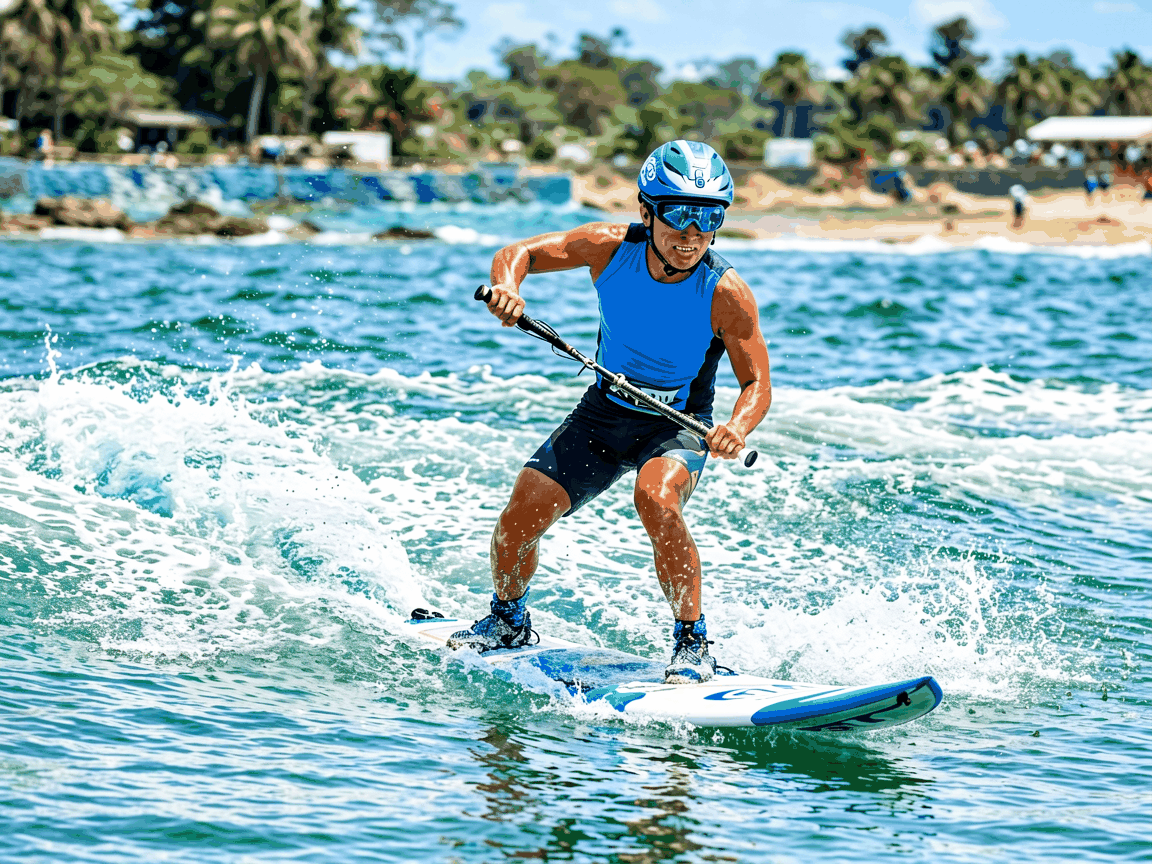
Riders must wear a personal flotation device (PFD) rated for water sports and consider a helmet in environments with collision risk from fixed objects or other craft. A wrist-attached safety lanyard connected to the kill switch is mandatory to prevent runaway boards upon fall. Operators should maintain minimum distances of 30 meters from swimmers, divers, and shoreline structures, adhering to local maritime regulations governing personal watercraft operation.
Pre-launch checks include verifying fuel level, inspecting intake grate for blockages, testing throttle return and kill switch function, and confirming secure foot strap engagement. Post-use rinsing with fresh water prevents salt crystallization in jet pump components and corrosion on metal fasteners. Storage should occur in a shaded, ventilated area away from direct sunlight and fuel sources to mitigate UV degradation and vapor accumulation.
Customization and Configuration Options
Manufacturers commonly offer engine size selection (15 hp, 20 hp, 25 hp) to match rider weight, intended use (training vs. performance), and local noise or emissions regulations. Hull length and width can be adjusted within 10–15% of standard dimensions to accommodate specific rider anthropometrics or stability preferences, though changes affect hydrodynamic behavior and require revalidation. Color schemes, graphics, and deck padding materials are typically customizable without impacting structural integrity.
Optional accessories include rear-mounted tow bars for inflatable tubes or wakeboards, GPS-enabled speedometers, and upgraded jet pump impellers for improved efficiency or top-end speed. Fuel tank capacity extensions are available but must maintain center-of-gravity limits to avoid handling degradation. All modifications should be evaluated by the manufacturer or a certified marine technician to ensure compliance with safety standards and warranty terms.