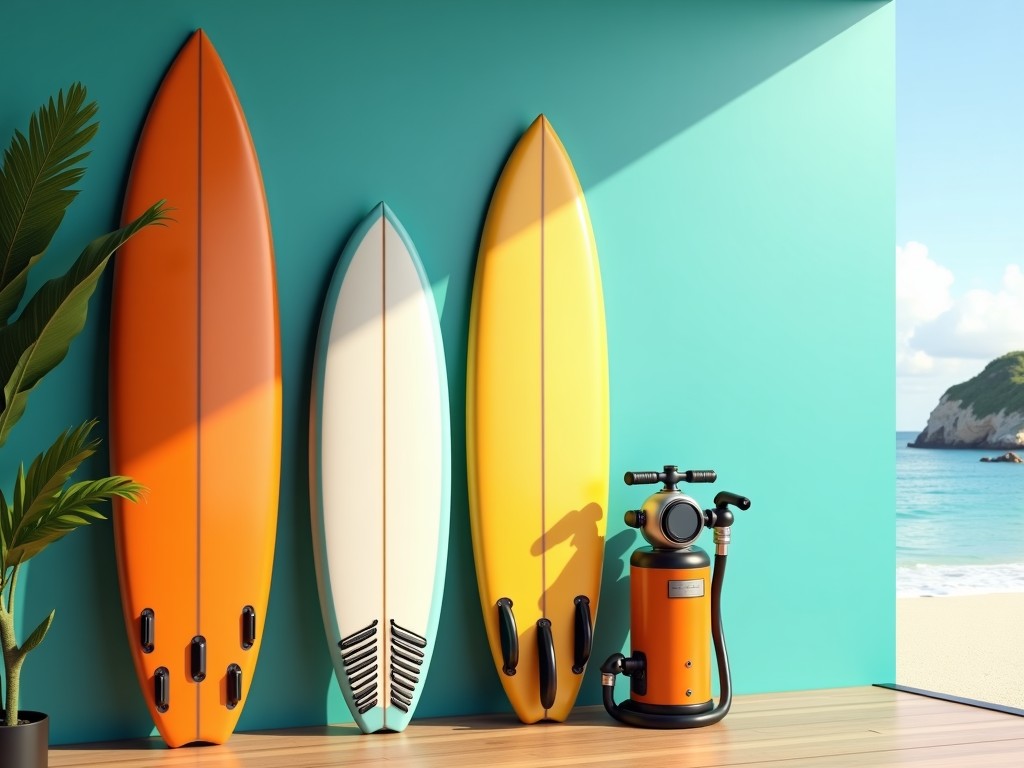
Gas Powered Surfboard Manufacturer
Gas Powered Surfboard Manufacturing: Engineering Considerations for Industrial Applications
Gas powered surfboards represent a niche segment of personal watercraft where internal combustion engines provide propulsion independent of battery constraints. Unlike electric variants, these systems rely on compact two-stroke or four-stroke engines mounted within a hydrodynamically shaped hull to deliver sustained thrust for wave riding or flat-water operation. Manufacturers serving industrial or commercial clients must address unique operational demands such as extended runtime, saltwater corrosion resistance, and rapid refueling capability—factors that influence material selection, engine integration, and safety system design.
The core challenge lies in balancing power-to-weight ratio with environmental durability. A typical gas powered surfboard engine produces between 5 to 15 horsepower, sufficient to propel a 30–50 kg board at speeds of 25–40 km/h depending on hull design and rider weight. Engine placement—commonly rear-mounted within a sealed compartment—affects center of gravity, cooling efficiency, and accessibility for maintenance. Industrial buyers evaluating these systems prioritize measurable attributes such as specific fuel consumption (g/kWh), corrosion rate in saline environments (mm/year), and mean time between failures (MTBF) under continuous operation.
Key Design Parameters Influencing Performance and Longevity
Hull geometry directly impacts hydrodynamic efficiency and stability. Planing hulls with reduced wetted surface area minimize drag but require precise angle of attack to maintain lift; displacement hulls offer greater stability at low speeds but increase resistance. Computational fluid dynamics (CFD) modeling is commonly used to optimize rocker lines, rail contours, and bottom shaping for specific use cases—such as rescue operations requiring quick acceleration versus patrol missions emphasizing endurance.
Material selection must account for prolonged exposure to UV radiation, salt spray, and fuel vapors. Marine-grade aluminum alloys (e.g., 5083-H116) are frequently used for structural components due to their strength-to-weight ratio and inherent corrosion resistance. Critical joints often employ stainless steel fasteners (A4-70 grade) with isolative coatings to prevent galvanic corrosion. Engine mounts and exhaust systems utilize heat-resistant composites or titanium alloys to manage thermal cycling without degradation.
Fuel system integrity is paramount for safety and reliability. Carbureted or fuel-injected systems must resist vapor lock under high ambient temperatures and prevent fuel leakage during capsize events. Typical installations include pressurized fuel tanks with vent valves, inline fuel filters rated for 10-micron filtration, and quick-disconnect couplings compliant with ISO 8434 standards. Return-line configurations help regulate fuel temperature and reduce vapor formation in enclosed engine bays.
Operational Specifications and Customization Pathways
| Parameter | Typical Range | Customization Notes |
|---|---|---|
| Engine Power Output | 5–15 hp | Scalable via cylinder bore/stroke; governed by emissions compliance (EPA/CARB) |
| Fuel Capacity | 2–5 liters | Tank geometry adaptable to hull contours; auxiliary tanks available |
| Dry Weight | 25–40 kg | Dependent on hull material and engine size; weight reduction via foam core composites |
| Maximum Speed | 25–45 km/h | Limited by propeller cavitation and hull stability; adjustable via pitch change |
| Operating Temperature Range | -10°C to 45°C | Cold-weather kits include pre-heaters; tropical variants feature enhanced cooling |
Customization extends beyond performance metrics to include application-specific interfaces. For maritime patrol units, manufacturers may integrate GPS tracking mounts, emergency beacon housings, or reinforced tow points rated for 15 kN loads. Rescue configurations often feature quick-release straps, high-visibility hull coatings (Pantone 801C or SOLAS orange), and detachable flotation modules. Commercial rental operators prioritize anti-theft locking mechanisms, hour meters for maintenance scheduling, and interchangeable engine mounts to accommodate different power units over the product lifecycle.
Modular design principles facilitate field serviceability. Engine cradles with standardized bolt patterns allow power unit swaps in under 30 minutes using basic hand tools. Exhaust systems employ clamp-on silencers with interchangeable baffle packs to meet local noise regulations (typically 75–85 dB(A) at 15m). Control cables—throttle, choke, and kill switch—are routed through sealed conduits with strain relief to prevent fatigue failure at pivot points.
Quality Assurance and Validation Protocols
Manufacturing consistency begins with material traceability. Each hull laminate batch is accompanied by resin supplier certificates detailing viscosity, gel time, and Barcol hardness. Engine assemblies undergo dynamometer testing to verify power output, fuel consumption, and emissions profiles before integration. Hydrostatic pressure testing of fuel systems at 1.5x operating pressure ensures leak-free performance under vibration and thermal cycling.
Finished units receive functional validation in controlled water environments. Tests include straight-line acceleration (0–30 km/h time), turning radius measurement at full throttle, and stability assessment during simulated capsize recovery. Salt fog exposure per ASTM B117 (500 hours minimum) evaluates coating adhesion and substrate corrosion. UV resistance is quantified using QUV accelerated weathering (1,000 hours) with post-exposure tensile strength retention as the acceptance criterion (>80% of baseline).
Documentation supports long-term operational reliability. Each unit ships with a build log listing critical torque values (e.g., engine mount bolts at 25 Nm ±10%), recommended break-in procedure (first 2 hours at variable throttle <75% power), and scheduled maintenance intervals based on engine hours rather than calendar time. Spare parts kits typically include impellers, spark plugs, fuel filters, and anode sets—items with predictable wear rates in marine environments.