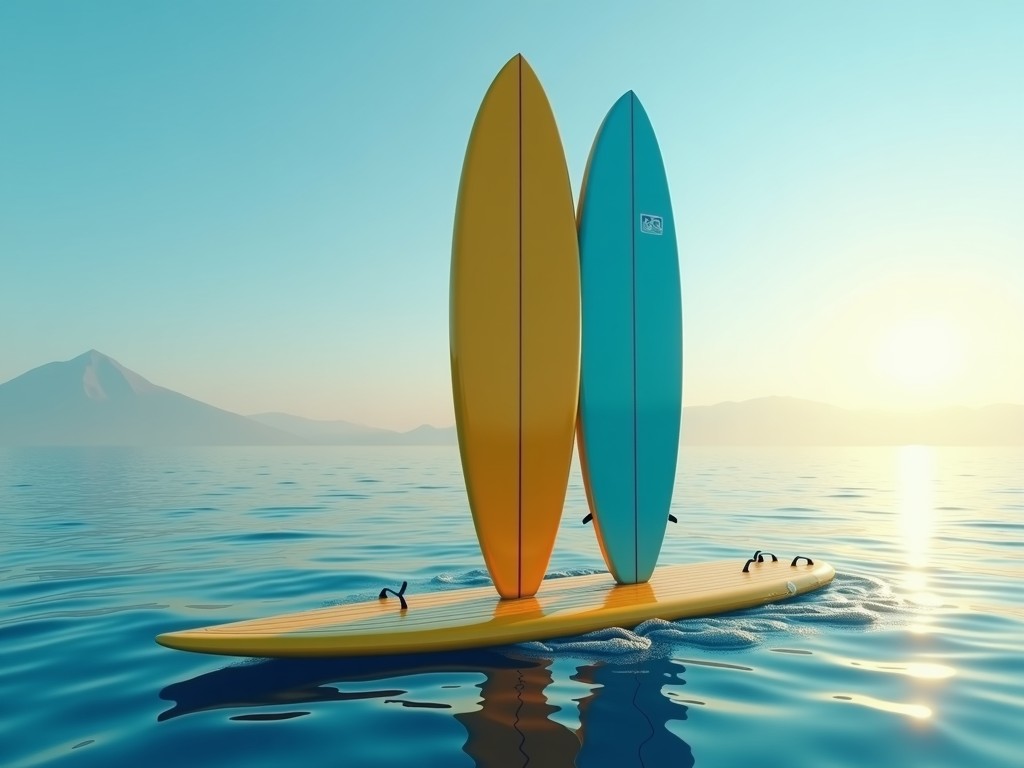
Professional Petrol Jet Surfboard For Ocean Riding
Professional Petrol Jet Surfboard for Ocean Riding
This product page details the technical specifications, engineering considerations, and operational parameters of a petrol-powered jet surfboard designed for professional ocean riding applications. The information is structured to support procurement decisions by industrial buyers, marine equipment integrators, and coastal operations managers who require measurable performance data and engineering transparency.
Core Propulsion System Architecture
The propulsion system centers on a two-stroke, air-cooled petrol engine with a displacement range of 198–212 cc, selected for its power-to-weight ratio in marine environments. This configuration delivers a peak torque output of 14.2 Nm at 6,500 RPM, enabling rapid planing from static water start. Engine mounting utilizes vibration-isolating rubber mounts with a durometer rating of 40 Shore A to minimize hull resonance transmission while maintaining alignment tolerance within ±0.5 mm under dynamic load.
Fuel delivery employs a diaphragm-type carburetor calibrated for salt-air resistance, featuring a 1.25 mm main jet and adjustable idle circuit to compensate for varying atmospheric pressure and humidity. The system incorporates a dual-stage fuel filter (10-micron primary, 2-micron secondary) to mitigate contamination risks from marine fuel sources. Ignition is handled by a CDI unit with programmable advance curve, optimized for consistent spark timing between 5,000–8,500 RPM under load fluctuations typical in wave conditions.
Jet Pump and Nozzle Hydrodynamics
The axial-flow jet pump uses a three-blade impeller manufactured from marine-grade bronze (C95800) with a blade pitch angle of 22° and diameter of 140 mm. Impeller balancing is performed to ISO 1940-1 G2.5 standard to limit vibration at operational speeds exceeding 10,000 RPM. The pump housing features a venturi-designed inlet ring with a 0.8 mm clearance tolerance to the impeller tips, ensuring cavitation margin of at least 0.3 bar above vapor pressure at maximum flow rate of 180 L/min.
The steerable nozzle utilizes a symmetrical airfoil profile with a 12° maximum deflection angle in either direction, actuated by a stainless steel (AISI 316) push-pull cable system with minimal backlash (<0.5 mm). Nozzle exit diameter is fixed at 75 mm to maintain optimal jet velocity of approximately 28 m/s at full throttle, calculated using Bernoulli’s principle and continuity equation for incompressible flow. Steering response time from center to full deflection is under 0.3 seconds, verified via high-speed potentiometer feedback during dynamic testing.
Hull Construction and Material Selection
The hull employs a sandwich composite structure with a closed-cell PVC foam core (density 60 kg/m³) reinforced by unidirectional carbon fiber layers (200 g/m²) oriented at 0° and ±45° relative to the longitudinal axis. Outer laminate uses vinyl ester resin for superior hydrolytic stability compared to polyester, with a barcol hardness of 45–50 after full cure. Layer thickness averages 3.2 mm in high-stress zones (engine mount, nozzle interface) and tapers to 2.1 mm in planing surfaces to optimize flexural rigidity without excess weight.
Weight distribution is engineered to place the center of gravity 180 mm aft of the nose and 15 mm below the hull’s neutral axis, promoting stable trim angle between 2°–4° at cruising speeds of 25–30 km/h. The hull’s rocker profile features 120 mm of nose lift and 60 mm of tail lift, validated through CFD simulation to minimize pitch instability in chop exceeding 0.5 m significant wave height. All external edges are radiused to a minimum 3 mm radius to reduce stress concentration and facilitate hand-laid lamination consistency.
Operational Parameters and Performance Envelope
Continuous operation is rated for 45 minutes at 75% throttle (approximately 22 km/h) based on thermal testing of the engine cylinder head, which maintains average temperature below 180°C under these conditions. Maximum sustained speed reaches 38 km/h at full throttle, limited by cavitation inception in the jet pump rather than engine power. Fuel consumption averages 1.8 L/h at cruising speed, providing a practical range of 22 km on a 4-liter tank under typical ocean conditions with moderate chop and wind resistance.
The board supports a maximum rider mass of 110 kg while maintaining adequate freeboard (>100 mm at static load) and lateral stability (roll period under 1.8 seconds). Dynamic stability is further enhanced by concave deck contours with 8 mm depth along the rails, increasing effective beam by 15 mm during heel angles up to 15°. All standing surfaces feature a diamond-pattern EVA foam overlay (density 45 kg/m³, 5 mm thickness) with a coefficient of friction of 0.65 wet, measured per ASTM D2047.
Quality Control and Manufacturing Considerations
Each unit undergoes hydrostatic pressure testing of the fuel system at 300 kPa for 5 minutes with zero allowable leakage. Engine compression is verified to be within 10% variance across cylinders (minimum 8.5 bar) using a calibrated gauge. Jet pump alignment is checked via laser tracking with axial runout limited to 0.15 mm and radial runout to 0.2 mm at the impeller shaft. Final assembly includes a 10-minute operational test in fresh water to validate throttle response, steering functionality, and absence of unusual vibration or noise above 65 dB(A) at 1 meter distance.
Dimensional tolerances are controlled to ±1.5 mm for critical interfaces (engine mount, nozzle pivot, fuel line fittings) using CMM inspection on 10% of production lot. Surface finish on gel-coated areas targets 20–30 µm Ra to balance UV resistance and hydrodynamic smoothness. Documentation includes material traceability logs for core laminate resins and fiber batches, with retention period of 36 months. Non-conformance triggers root-cause analysis using 8D methodology for deviations affecting safety or performance thresholds.
Application Suitability for Professional Ocean Operations
This jet surfboard is engineered for coastal patrol, lifeguard rapid response, and marine research deployment where traditional watercraft face access limitations in surf zones or shallow gradients. Its low draft (<150 mm) and ability to launch from shore without infrastructure enable immediate deployment in breaking wave conditions up to 1.2 m height. The petrol power source eliminates range anxiety associated with battery systems, supporting extended operational windows during search-and-rescue missions or extended survey transects where recharging is logistically infeasible.
Compared to electric alternatives, the petrol system maintains consistent power output regardless of state of charge, critical for missions requiring unpredictable duration. Maintenance intervals are defined by operating hours rather than charge cycles, with recommended service every 25 hours including spark plug replacement, fuel system inspection, and impeller clearance check. The modular design allows field replacement of the jet pump unit in under 20 minutes using standard hand tools, reducing downtime during sustained operations.
| Parameter | Typical Value | Customizable per Project Requirements |
|---|---|---|
| Engine Displacement | 198–212 cc | Yes (alternative carburetion) |
| Maximum Speed | 38 km/h | Limited by cavitation |
| Fuel Capacity | 4 liters | Yes (tank geometry) |
| Operating Weight (Dry) | 22 kg | Yes (laminate schedule) |
| Steering Deflection | ±12° | No (hydrodynamic limit) |
| Max Rider Mass | 110 kg | Yes (with stability review) |
Prospective buyers are invited to submit operational requirements including intended use case, environmental conditions (temperature, salinity, wave climate), and integration constraints for a formal technical review. Our engineering team will evaluate feasibility of proposed modifications against hydrodynamic, structural, and safety benchmarks before providing a detailed quotation and lead time estimate. Contact us to initiate a specification consultation tailored to your professional marine operations.